



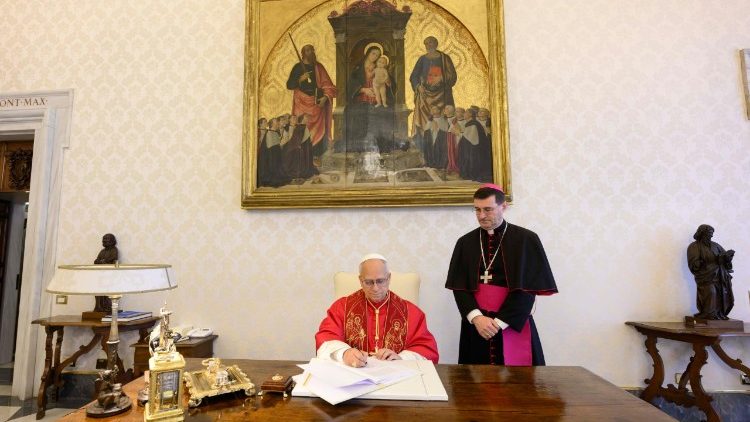
On May 25, 2026, Pope Leo XIV released his first encyclical, Magnifica humanitas: On Safeguarding the Human Person in the Time of Artificial Intelligence. Signed on May 15, the 135th anniversary of Pope Leo XIII’s Rerum novarum, the document addresses AI through the lens of Catholic social doctrine. “Humanity, created by God in all its grandeur, is today facing a pivotal choice: either to construct a new Tower of Babel or to build the city in which God and humanity dwell together,” the Pope writes in the opening lines. Technology, he says, is not “a force antagonistic to humanity” nor “inherently evil,” but “never neutral, because it takes on the characteristics of those who devise, finance, regulate, and use it.”
The first chapter traces the Church’s social doctrine from Pope Leo XIII to Pope Francis, emphasizing its “dynamic character” as a “theology of communion in history” rather than a handbook of rules. Pope Leo XIV recalls that each successor of Peter has “interpreted historical changes according to the Gospel,” bringing out aspects of a single heritage: the dignity of the person, the value of work, the universal destination of goods, solidarity, subsidiarity, care for creation, and the centrality of peace and fraternity.
The second chapter sets out the foundations: the dignity of the person created in God’s image, the inviolability of human rights including the right to life “from conception to its natural end,” and the rights of minorities, with a call for concrete decisions to ensure women are heard and valued. He identifies five principles. The common good, he says, “can never be separated from respect for the right of peoples to exist” and “any attempt or plan to eliminate or subjugate a nation is gravely immoral.” The universal destination of goods requires that technologies not be concentrated in the hands of a few. Subsidiarity calls for shared responsibility over paternalistic management. Solidarity opposes indifference and considers future generations. Social justice demands fair access to opportunity and public oversight of technology, with migrants, refugees, and displaced persons as a “litmus test.” The Pope adds that these principles apply to the Church herself, calling for an “examination of conscience” to purify ecclesial structures of inequality, lack of transparency, and abuse, and to listen to victims of spiritual, economic, institutional, sexual, and power-based abuse.
The third chapter warns against the “technocratic paradigm” that reduces choices to efficiency and profit. AI can imitate human functions but lacks moral conscience, empathy, and spiritual capacity. The Pope calls for clarity on responsibility, legal frameworks, independent oversight, user education, and an ethical code grounded in shared standards of social justice. AI must be “disarmed,” he writes, to prevent technical power from becoming the right to govern. He critiques transhumanism and posthumanism for treating human limits as defects, insisting that “humanity flourishes not despite limitations, but often through them.” Technological progress must not come at the cost of “anthropological regression.”
In chapter four, Pope Leo XIV calls for an “ecology of communication” based on truth, transparency, data protection, and serious journalism. Schools must nurture the “desire to ask questions” so young people are not discouraged by machines that make human thought seem useless. He emphasizes protecting the dignity of work, warning that AI often forces workers to adapt to machines rather than the reverse. Technology should free people from burdensome tasks, not cause unemployment for profit. He also urges moving beyond GDP as the measure of development, focusing instead on dignity, shared prosperity, reduced inequality, and environmental care. The family, founded on the stable union of a man and a woman, is the “primary social good” and must be supported through labor policies that allow stability and humane rhythms.
The Pope warns against the “architecture of visibility” on digital platforms that captures attention and exploits vulnerability, and against the mass collection of data that enables profiling and social control. He denounces new forms of slavery linked to the extraction of rare earth elements and asks forgiveness for the Church’s past delay in condemning slavery. On war, he says the digital revolution makes conflict more impersonal and lowers the threshold for violence. Algorithms do not make war morally acceptable. He reiterates that while the right to legitimate defense remains, the theory of “just war” must be overcome in favor of dialogue, diplomacy, and forgiveness.
He calls for strict ethical limits on AI weapons and reforms to the UN to restore multilateralism. Christians, he concludes, are called to build “the civilization of love” through disarming words, justice, solidarity with victims, realism in pursuing peace, and interreligious dialogue. “Those who use the name of God to legitimize terrorism, violence or war betray his true nature,” he writes, and urges prayer, since peace comes above all from God.