



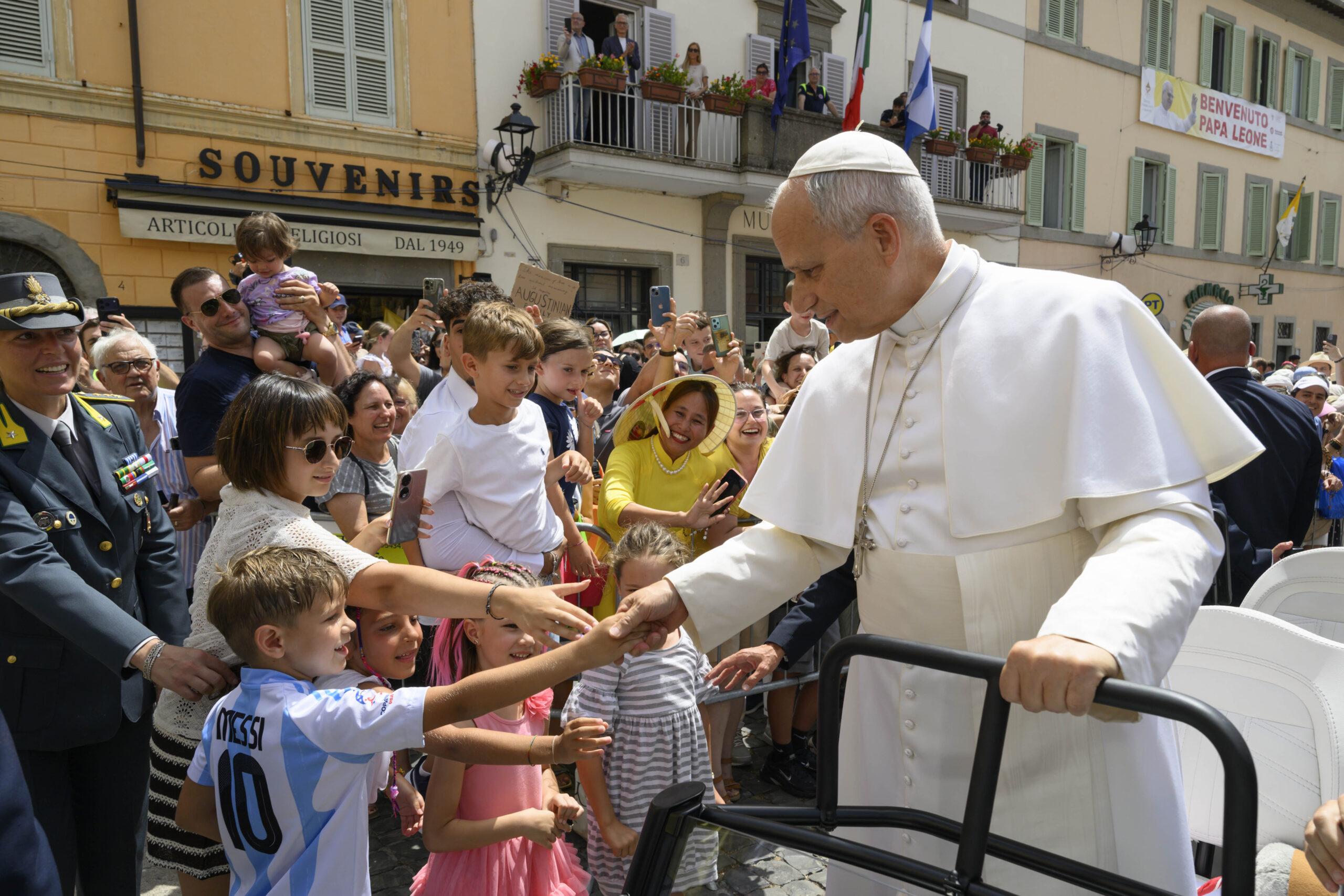
Pope Leo XIV lamented that prayer is being lost in Christian families and that many now see it as something “useless,” calling instead for its rediscovery “in its truth.”“Even in many Christian families, prayer is no longer passed on, while many people risk confusing it with just another technique, of a psychological nature and geared towards personal well-being,” the Pope said during the General Audience on Wednesday, August 5. The Pope, who suspended his schedule in July for the summer break, resumed public audiences this week. Due to the high temperatures of the Roman summer, the audience was held inside St. Peter’s Basilica.
Focusing on the conciliar constitution Sacrosanctum Concilium, specifically on the ecclesial dimension of liturgical prayer, Leo XIV reflected on how society views prayer today.“In a society dominated by a mentality focused on efficiency and consumerism,” he said, prayer can come to be perceived as “useless and ridiculous.” “In a world where science and technology claim to provide all the answers, praying can seem like a form of escapism,” he observed. “Prayer, on the other hand, as a fundamental dimension of our humanity, deserves to be rediscovered in its truth.”
The Pope noted that Sacrosanctum Concilium took this need seriously. He recalled words spoken by Saint Paul VI in St. Peter’s Basilica on December 4, 1963, when promulgating the first document approved by the Second Vatican Council: “God in the first place; prayer, our first obligation; the liturgy, the first source of the divine life that is communicated to us, the first school of our spiritual life.”As the Pope explained, in the Constitution the term “prayer” designates the entire liturgy. This is a “decisive” perspective because it guided the liturgical reform by placing the active participation of the faithful at the center.The liturgy, he said, is the place of “encounter” and of God’s initiative, who approaches humanity in his Son, “the Word made flesh, anointed by the Holy Spirit.” To this divine initiative, the faithful can respond “through Christ, with Christ and in Christ, in the unity of the Holy Spirit” — that is, through “the prayer of Christ, with his Body, to the Father.”
Leo XIV also recalled that Saint Paul VI ardently desired that the Liturgy of the Hours — the daily public prayer of the Church and inseparable from the Eucharist — should permeate, revive, guide and express all Christian prayer, nourishing the spiritual life of the people of God.For this to become a reality, he said, the Liturgy of the Hours must be increasingly embraced in the daily lives of the baptized and of communities.“The Liturgy of the Hours sanctifies the time of our daily lives: in the morning, we begin the day with joy and gratitude; at midday, we ask for the strength of fidelity in the midst of fatigue; in the afternoon, once the work is finished, Vespers accompany us at sunset; at night, we go to sleep entrusting ourselves to the peace of God,” he observed.He added that it can become a true school of prayer for those who wish to learn, especially catechumens. “To so many people who want to learn to pray, in particular to catechumens, it can offer the path and the school of Christian prayer,” he concluded.