



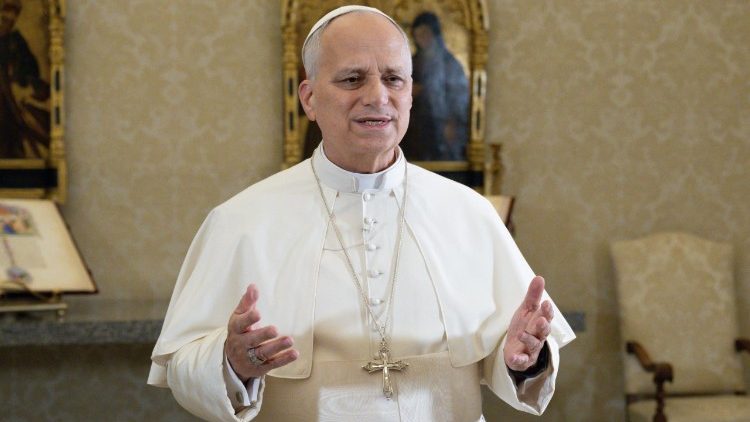
During the Angelus prayer this Sunday, Pope Leo XIV encouraged the faithful to rediscover the blessing of the table as a simple expression of faith and as a concrete way of transmitting the “beauty” of the Eucharist in everyday life.As we savour the grace of the Eucharist, let us commit ourselves to bearing witness to its beauty in our daily gestures, beginning with the blessing of the table, when we share bread with family and friends,” the Pope said from the balcony of the Apostolic Palace in the Vatican. He resumed the Marian prayer after concluding three weeks of summer rest in Castel Gandolfo.
In his reflection, Leo XIV commented on the Gospel account of the multiplication of the loaves and fishes proclaimed in the liturgy this Sunday. He explained that Jesus’ actions reveal the profound meaning of his saving mission. “These are actions that manifest his special self-giving for us, that is, the salvation he brings to the world,” he said.The Pope emphasized that Christ not only performed extraordinary miracles, but through them announced the nearness of the Kingdom of God. “The Lord presents himself as the one who gives meaning to life, freeing it from evil and sin. By giving sight to the blind and hearing to the deaf, Christ not only performs miraculous acts, but also announces to everyone that the Kingdom of God is near,” he affirmed.From this perspective, he noted that the Gospel shows how Jesus transforms human existence in a holistic way. This Sunday’s biblical text, he said, “testifies that Jesus does not merely give senses to those who lack them, but rather awakens the pleasure of our senses.”
The Holy Father explained that the multiplication of the loaves is an eloquent image of the encounter with Christ. “The episode of the multiplication of the loaves signifies that the encounter with the Lord is an experience that nourishes us,” he said. “In the desert, that is, in the place of our need, Christ is the bread of life.”He recalled that the Lord responds to the deepest longings of the human heart. “Christ truly satisfies humanity’s hunger, our hunger for truth and life.” At the same time, he emphasized that the miracle conveys a fundamental lesson about solidarity and sharing. In contrast to the logic of selfishness, Leo XIV warned against a culture centered on accumulation. “His gesture teaches us that nothing is lost when it is shared.” “Accumulation and discarding, on the other hand, are two sides of the same coin: greed,” he pointed out.
The Pope described it as a “disease of the soul” that “leads to a loss of senses because it intoxicates with riches, to the point of forgetting those who cry from hunger and scream from thirst.”He also denounced the contradictions of a world marked by deep inequalities and conflicts: “Before the opulence of things that are corrupted, there are the outstretched hands of those who have nothing to eat, the destroyed houses of those who have no peace.”In evoking the current context of wars and international tensions, he invited everyone to contemplate the miracle of the loaves as a manifestation of divine charity. “In this miracle of charity, we recognize the typical actions of Jesus, which culminate in the Last Supper, where the Son of God gives us his very life as our brother in humanity,” he affirmed. Finally, Leo XIV reminded everyone that even vacation time can become an opportunity to experience fraternity and care for those most in need. “Jesus, even vacations can become a time of serene fraternity, including those who are close to us and in need.”