



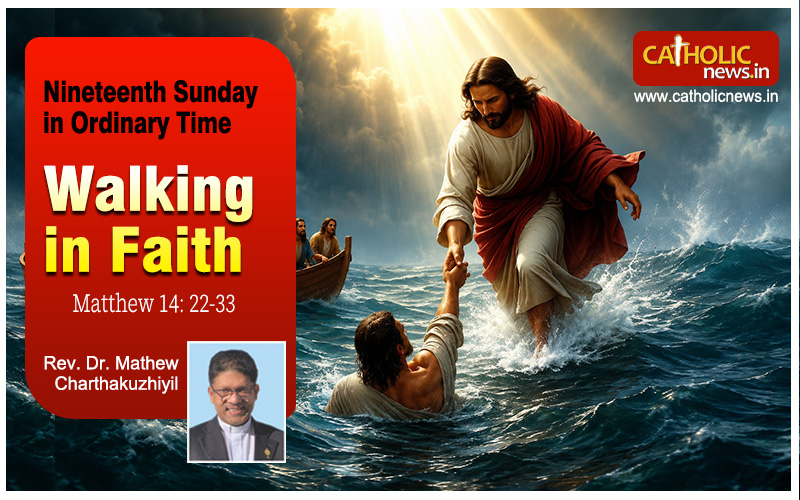
Today’s Gospel begins with Jesus sending his disciples across the lake while he goes up the mountain to pray. After feeding the crowd, Jesus does not seek praise for his success. He seeks the presence of his Father. Prayer is not an escape for Jesus; it is the source of his strength and peace. Meanwhile, the disciples are far from land, struggling against the wind and waves. They are doing what Jesus asked, yet they encounter a storm. Faithfulness does not mean that life will always be calm. We can follow the right path and still face illness, disappointment, conflict or fear. It may seem that Jesus is far away, but while the disciples struggle, he is already coming toward them.
When the disciples see Jesus walking on the water, they are terrified because they do not recognize him. Fear changes the way we see. It can make help look like danger and hope look impossible. Jesus says, “Take courage, it is I; do not be afraid.” The Lord is present in the place that frightens them. Peter responds courageously: “Lord, if it is you, command me to come to you on the water.” Jesus says, “Come.” Peter steps out because he trusts Christ’s word. The boat represents what is familiar and secure, while the water represents the unknown. Every act of faith requires such a step: forgiving someone, beginning again, accepting a vocation, serving others or trusting God when the future is unclear.
At first, Peter walks toward Jesus. Then he notices the wind and becomes afraid. The wind was present when he left the boat, but it gains power when his attention moves away from Christ. Christians should not ignore problems or pretend that storms are unreal. Rather, our problems must not become greater in our minds than the Lord who accompanies us. We may begin with confidence and then become distracted by anxiety, temptation, criticism or past failures. When Peter starts to sink, he does not offer a perfect prayer. He cries, “Lord, save me!” It is one of the shortest and most honest prayers in Scripture. At once Jesus stretches out his hand. Peter’s weakness does not cancel the mercy of Christ.
Peter is not a false disciple; he is a real disciple with both faith and weakness. One moment he is brave, and the next he is afraid. He resembles all of us. Each person carries wounds, regrets and struggles that others may not see. We should never believe that our failures place us beyond God’s reach. Jesus asks Peter, “Why did you doubt?” but he asks while holding him. Correction comes after rescue, not before it. The hand of Jesus remains available in prayer, Scripture, the Eucharist, Reconciliation and the care of the Christian community. We must also notice those sinking near us. A relative, friend or neighbour may need someone to listen, encourage, forgive or accompany them. Christ may extend his saving hand through ours.
When Jesus and Peter enter the boat, the wind dies down, and the disciples worship him, saying, “Truly, you are the Son of God.” The storm leads them to a deeper knowledge of Jesus. Our storms can also become places of encounter, not because suffering is good, but because Christ meets us there. We may not overcome every difficulty, and the waves may not disappear immediately. Yet we are never abandoned. The Lord who prayed on the mountain, walked across the sea and lifted Peter from the water is present with us today. Let us leave this church holding God’s promise from Isaiah: “Do not fear, for I am with you; do not be anxious, for I am your God. I will strengthen you, I will help you.” The sea may be great and we may feel small, but Christ is greater. Keep your eyes upon him, call his name and take his hand.
Fr. Mathew Charthakuzhiyil