



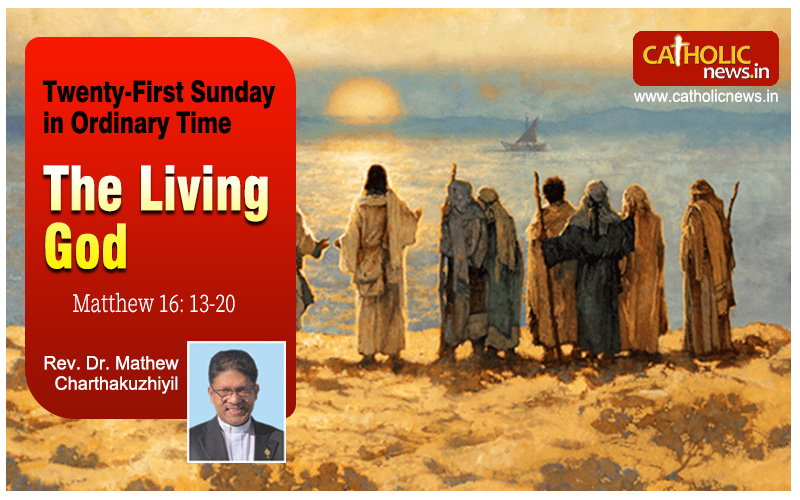
In today’s Gospel, Jesus is preaching in the region of Caesarea Philippi. Caesarea was named after Augustus Caesar, the Roman Emperor at the time of the birth of Jesus, and Philip, the ruler of the region, later added his own name to the city. It was inhabited by Greeks and Romans and had temples dedicated to Baal and other pagan gods. Surrounded by symbols of political power and false worship, Jesus chose this very place to ask the most important question in history: “Who do people say that the Son of Man is?” The disciples repeated the opinions they had heard. Some believed he was John the Baptist, others Elijah, Jeremiah, or one of the prophets. Then Jesus asked a much more personal question: “But who do you say that I am?” Peter immediately answered, “You are the Christ, the Son of the living God.” This question and Peter’s profession of faith remain at the very heart of Christianity. Every generation, including our own, must answer it personally.
First of all, Jesus is not interested merely in public opinion but in personal faith. It is easy to repeat what others think about Christ, but it is much more challenging to say what he truly means to us. Today many people admire Jesus because they appreciate his teaching, his kindness, his compassion, or his concern for the poor. But we believe something much greater. Jesus is not simply a wise teacher or an extraordinary man; he is our Lord and Saviour, the Son of the living God. Our faith cannot rest upon tradition alone or upon what others believe. It must become our own personal conviction. Every time we profess the Creed, receive Holy Communion, or make the Sign of the Cross, we renew Peter’s confession of faith. Jesus continues to ask each one of us, “But who do you say that I am?” May our answer always come from the depths of our hearts: “Lord, you are my Saviour. I trust you, I love you, and I want to follow you always.”
Secondly, knowing Jesus is much more than knowing facts about him. Christianity is not simply a religion of rules or traditions. It is a living relationship with the person of Jesus Christ. Jesus wants to be more than someone we know about; he wants to become the centre of our lives. When we spend time with him in prayer, listen to his Word, celebrate the sacraments, and receive him in the Holy Eucharist, our friendship with him grows stronger. The saints became saints not because they knew many things about Jesus, but because they loved him deeply and allowed him to transform their lives. The closer we remain to Christ, the more we begin to think, forgive, serve, and love like him. A personal relationship with Jesus gives meaning, direction, and lasting joy to our lives.
Finally, when Jesus becomes everything for us, our faith naturally becomes a witness to others. Peter’s profession of faith became the foundation upon which Christ built his Church. In the same way, our families, our parish, and our society need believers who are not ashamed to proclaim their faith. The world needs disciples who live the Gospel with joy and conviction. Let us answer Jesus today as Peter did: “You are the Christ, the Son of the living God.” Let us also pray: “Jesus, you are everything for me. I love you dearly. I need you in my life. Take possession of my heart and guide my every step.” Strengthened by this Holy Eucharist, may we leave this church ready to love our brothers and sisters, so that through our words and actions others may discover the joy of believing in Jesus.
Fr. Mathew Charthakuzhiyil