



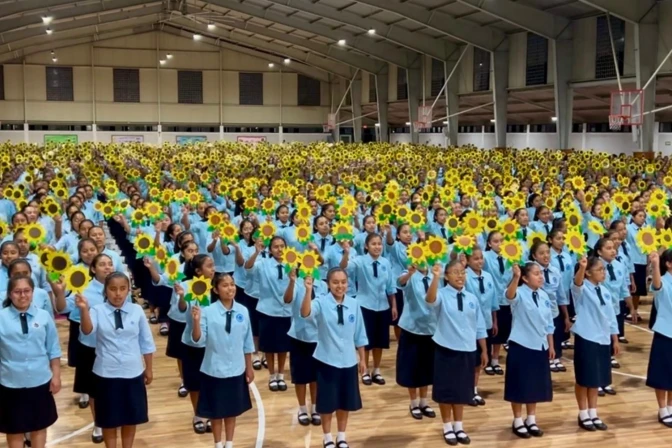
Ivonne dreams of becoming an electronics engineer. Paloma imagines a future as a pastry chef. Teodora wants to dedicate herself to fashion design. For many teenage girls from vulnerable backgrounds in Mexico, these goals might seem out of reach without opportunities. That’s what the Villa de las Niñas (Girls’ Village) in Chalco, State of Mexico, provides. Like them, 3,200 children live and study at the institution founded by the now Venerable Father Aloysius Schwartz and administered by the Congregation of the Sisters of Mary. The school has transformed the lives of thousands of young people.
Sister Viviana, a former student who now accompanies new arrivals, explained the mission: “to help the poorest children or those who lack resources.” Father Schwartz wanted children limited by economic hardship “to be guided in a spiritual and academic way and also strengthen their values.” “Primarily, what we are looking for is for these girls and boys to be able to leave their places of origin, prepare themselves academically and later return to their places of origin to help their families,” she said. The day begins at 6 a.m. Sister Araceli, who entered the Village at age 12 and now cares for students, said the routine combines studying, community service, and sports. After breakfast at 7 a.m., the girls help with dishes, sweeping, cleaning common areas, and facility maintenance before classes start at 8 a.m. In high school, students choose technical fields like manufacturing, gastronomy, computer science, accounting, electronics, and garment making. Nursing will soon be added. Sports including swimming, handball, hockey, soccer, basketball, and track and field are also part of daily life. For 16-year-old Teodora Itzel Escalante Baltazar, the best part is doing everything together. “Here we all do everything,” she said — from playing to praying.
Faith education isn’t taught as just another subject. It’s integrated into daily life. Nathalí Fabiola Galván González, 17, said her relationship with God motivates her every day: “My faith has helped me grow spiritually and face my problems from afar, but always praying for my family and for all the problems at home.” Sister Viviana believes this support is essential. Regardless of past suffering, she teaches that “true happiness is found in God.” “God is the center of everything and that is what we want our girls to understand,” she insisted. The Villa also fosters religious vocations. Discernment groups for young women interested in consecrated life begin in their third year of secondary school, and the Rosary is prayed daily. Paloma Guadalupe Magaña Hernández, 14, learned that with faith it’s possible to overcome mistakes so as “not to stay in the same place, but to move forward and keep in mind that there is a God and that God is always with you.”
The Sisters of Mary’s work is critical in Mexico, where CONEVAL reported about 19.5 million people under 18 lived in poverty in 2020. UNICEF said nearly 4 million children and adolescents do not attend school, and only 4 out of 10 youth in extreme poverty continue after secondary school. The admissions process sends nuns for months to pre-selected communities to assess applicants’ circumstances. Many come from places lacking basic services like water or electricity. Sister Araceli recalled girls often arrive with “a sad face or difficulties adapting,” but over time “they adapt and in the end they reflect a confidence, a joy, an excitement that there are new things to learn every day.”
Castillo admitted leaving her family was difficult, but she’s motivated by a desire “for excellence and persevere; to provide for my family.” “It’s what I’ve always wanted, and growing as a person is what motivates me the most,” she said. A global model of care
The Sisters of Mary model extends beyond Mexico. In addition to Villa de las Niñas in the State of Mexico, they run a home for boys in Jalisco. Similar institutions exist in Guatemala, Honduras, the Philippines, Brazil, Tanzania, and South Korea, where the work began.
Fr. Caleb Krischke from the Diocese of Victoria, Texas, who spent a week at the Village accompanying sacramental celebrations, said: “I learned that our Church is alive and has a special maternal concern for the poor.” He encouraged Catholics to support charitable works, since “our Lord Jesus Christ himself identified with the poor, with those who cry out from the depths of their hearts for help and assistance.”