



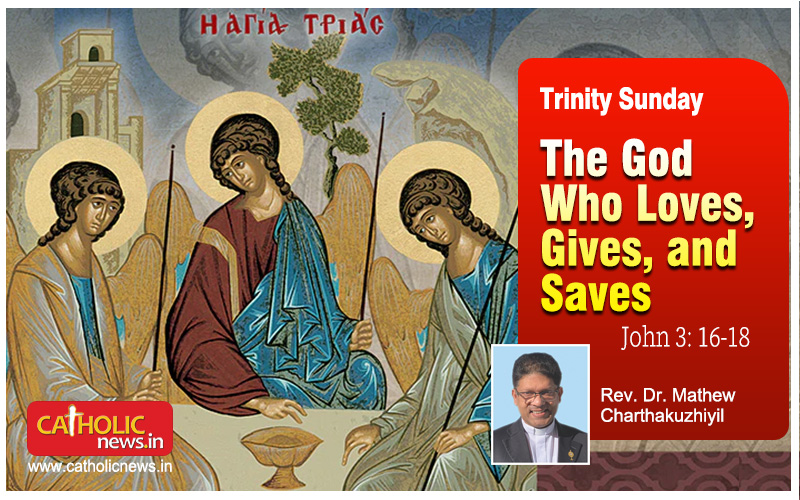
Today the Church celebrates one of the deepest mysteries of our faith: the Holy Trinity — one God in three Persons: Father, Son, and Holy Spirit. Many people think the Trinity is only a difficult theological idea. But today’s Gospel shows us something very beautiful and practical: the Trinity is not first a puzzle to solve, but a relationship of love into which we are invited. Jesus says: “For God so loved the world that he gave his only Son, so that everyone who believes in him may not perish but may have eternal life.” These words reveal the heart of God. The Father is the source of love. He does not remain distant from humanity, but loves the world deeply with all its weakness and sin. Before we searched for him, he searched for us. God begins not with condemnation, but with love.
The Gospel also reveals the Son. The Father “gave” his Son to the world. Jesus is the visible face of God’s love. He came into our world, carried our suffering, forgave sinners, touched the sick, welcomed the rejected, and died on the cross for us. The cross is therefore not a sign of defeat, but the greatest revelation of divine love. In Jesus, God does not simply speak about love — he lives it. Even though the Holy Spirit is not mentioned directly in this passage, the Spirit is silently present. It is the Holy Spirit who opens our hearts to faith, helps us pray, strengthens us in difficult moments, and keeps the presence of Christ alive in the Church. Without the Holy Spirit, faith would remain only an idea; the Spirit transforms faith into life.
The Trinity also teaches us something important about human life. God himself is relationship. The Father loves the Son, the Son loves the Father, and the Holy Spirit is the bond of eternal love between them. This means that we are created not for selfishness or isolation, but for communion, love, and unity. One of the great sufferings of modern society is loneliness. Many people are surrounded by technology and yet feel deeply alone. Families sometimes live in the same house without truly speaking to one another. People carry wounds, resentments, and silent pain in their hearts. Trinity Sunday reminds us that love and communion are at the center of life itself.
A family reflects the Trinity when there is forgiveness instead of pride, listening instead of shouting, prayer instead of indifference, and sacrifice instead of selfishness. A parish reflects the Trinity when people support one another, work together, and welcome others with kindness. Even small acts — visiting the sick, helping a lonely neighbor, encouraging someone who is discouraged — become reflections of the life of the Trinity. Jesus also tells us in today’s Gospel: “God did not send the Son into the world to condemn the world, but that the world might be saved through him.” Many people live with fear: fear of failure, fear of judgment, fear that God has rejected them. But Jesus came not to destroy, but to save. Christianity is centered not on fear, but on grace and mercy.
The mystery of the Trinity is therefore not far away from daily life. Every time we make the Sign of the Cross — “In the name of the Father, and of the Son, and of the Holy Spirit” — we proclaim the God who created us, saved us, and continues to guide us. We begin our Christian life in the Trinity at Baptism, and one day we hope to enter fully into the eternal communion of heaven. Trinity Sunday invites us not simply to think about God, but to live in the love of God. May our homes, our parish communities, and our hearts become living reflections of the Holy Trinity — places where love is shared, mercy is practiced, and faith becomes visible in daily life.
Fr. Mathew Charthakuzhiyil