



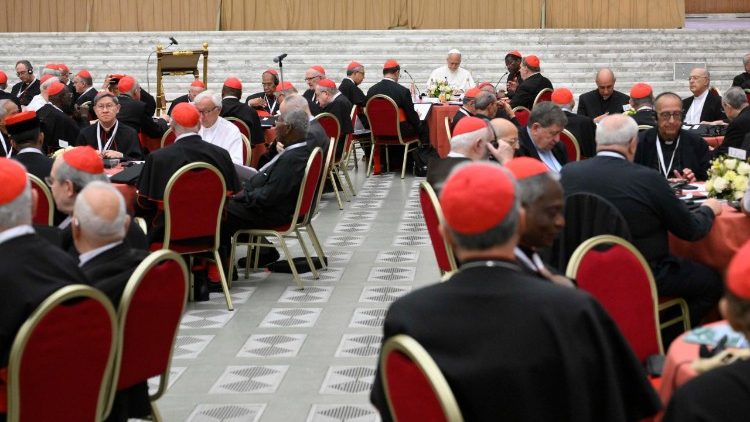
The Holy See Press Office released details from the third session of the Extraordinary Consistory, held Saturday morning in the Paul VI Hall. The day began with Mass celebrated by Cardinal Giovanni Battista Re, Dean of the College of Cardinals, in St. Peter’s Basilica. Pope Leo XIV opened the session by leading the Cardinals in the Adsumus prayer. Cardinal Protase Rugambwa, Archbishop of Tabora, Tanzania, moderated the morning session. He thanked the College, on the Pope’s behalf, for supporting his appeals for peace. He urged the cardinals to make those appeals more effective by taking responsibility for them in their own dioceses and regions, so that a united call for peace may strengthen their common commitment.
Cardinal Stephen Brislin, Archbishop of Johannesburg, South Africa, then delivered an introductory report on the theme “Building in the good: the worksites of our time.” After a time of prayer and silence, the cardinals broke into group discussions before reconvening in plenary at 11:30 a.m. Pope Leo XIV, who had been present at the start, returned before the groups delivered their reports. Eleven groups presented in the Hall. Many focused on the deep fractures of the present moment — among peoples and nations, within societies, and inside families.
These divisions, they said, wound the poorest, the weakest, young people who lack a sense of newness, and adults lacking the wisdom of years. A recurring concern was a widespread lack of meaning, meaningful relationships, and identity, which can drive people toward tribalism. The reports also pointed to exaggerated individualism that creates the illusion that others exist for personal success.In this context, artificial intelligence emerged as a key anthropological challenge. The groups said it must be examined through shared human values. That means naming living beings rather than reducing them to numbers and statistics, accepting the human sense of limits that AI tends to deny, and defending the dignity of work.Many groups spoke of the difficulty of embracing the common good, noting that politics often does not seek it.
Achieving it, they said, requires a “language of the heart” to overcome conformism, corruption, and the sense of impossibility that comes from resources being held by a few. The sense of the common good, numerous groups affirmed, has its origin in faith: faith in God and in the transcendent dignity of every person. That faith pushes people beyond themselves, toward solidarity with the poor, toward lived catholicity, and toward building gratuitous relationships rather than institutions.
It also demands a language capable of reaching those distant from Christianity.Politics was seen as essential, along with the Church’s role in forming future public servants so that Catholic social doctrine is known and studied as a remedy for division. The antidote to individualism and fracture, many groups agreed, is the Gospel. They called for a Church that offers belonging, soothes the wounds of the time, and renews itself while avoiding integralism and polarization. It should show a Samaritan face, with Christians who are not spectators of social ruin but wise architects who rebuild the city for all.
A sign of hope, the groups noted, is that many regions face the same challenges, and communion with Christ frees believers from concern over what others think. Several groups emphasized synodality as a path of listening, dialogue, and ecclesial responsibility.After the reports, several cardinals spoke in more personal terms, taking up the session’s themes. Others thanked the Pope for his recent apostolic journeys and his commitment to peace. The session ended at 12:45 p.m. with the Angelus prayer, led by Pope Leo XIV.