



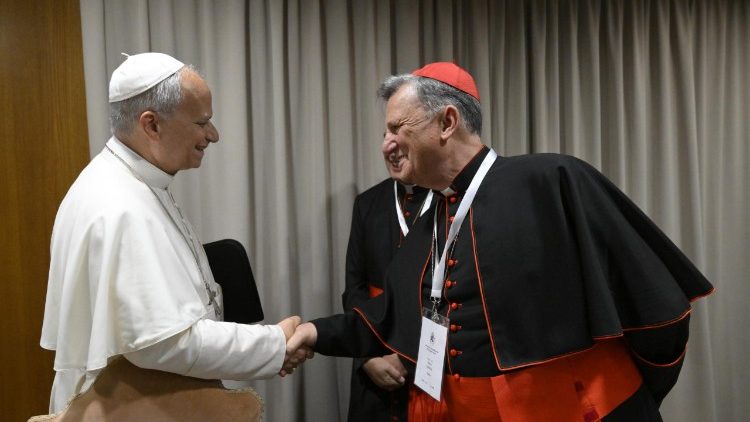
Cardinal Mario Grech, Secretary General of the Synod, told the fourth session of the Extraordinary Consistory that the Synod’s strength lies in “gentle listening” — a humility of dialogue that contrasts with a geopolitics resigned to war and economic coercion. Speaking on the afternoon of June 27, he framed the Synod’s new implementation phase not as simply applying decisions, but as letting the insights gained mature within the life of communities. Recalling the Synod on Synodality that began in 2021, Cardinal Grech noted that “few would have imagined the breadth of involvement it would generate.” Different parts of the Church took part, some for the first time, in listening and ecclesial discernment.
Despite fatigue and resistance, he said, there was a universal desire to “walk together, valuing the gifts and responsibility of all.”The synodal experience, he explained, has been shaped by “conversation in the Spirit.” This method helped participants grasp the difference between thematic spiritual conversation and true conversation in the Spirit — “the mutual speaking and giving of the Risen Lord among us as a work of the Spirit.” The implementation phase now underway will let Churches exchange gifts and experiences, deepening “the sense of belonging to the one People of God.” Cardinal Grech cautioned that this is not immediate.
Each culture will receive and interpret the synodal insights in its own time and way — through cultures, institutions, pastoral practices, and ecclesial relationships.To guide the process, the General Secretariat of the Synod has laid out a path leading to an ecclesial Assembly in October 2028. The aim is to translate the Synod’s insights into community life while fostering deeper exchange among Churches that are geographically and culturally distant. The ministry of the bishop remains fundamental, he stressed, in promoting the participation of the whole People of God. Working alongside bishops are synodal teams, participatory bodies, ordained ministers, consecrated men and women, associations, movements, schools, families, young people, and local communities.Cardinal Grech outlined four verbs that mark the stages of implementation: “to remember,” helping communities foster an exchange between Churches that nourishes communion and supports mission by welcoming what has already emerged; “to interpret,” reading shared dynamics and tensions; “to orient,” opening the Church to new perspectives; and “to celebrate,” bringing the journey back to the goal of unity.He also drew a link between the Consistory and the synodal path.
The gathering of cardinals, he said, does not happen “outside a matured ecclesial spirituality that is broadly synodal.” The shared presence of the Holy Spirit reveals “two operative dimensions of the same communion”: the Consistory as a “living memory of the collegial communion” Christ gave his first disciples as a style of governance, and synodal assemblies as the “living memory of that fraternal and theological communion” that makes each local Church a sacramental participant in salvation — now called to renewed discernment and witness.