



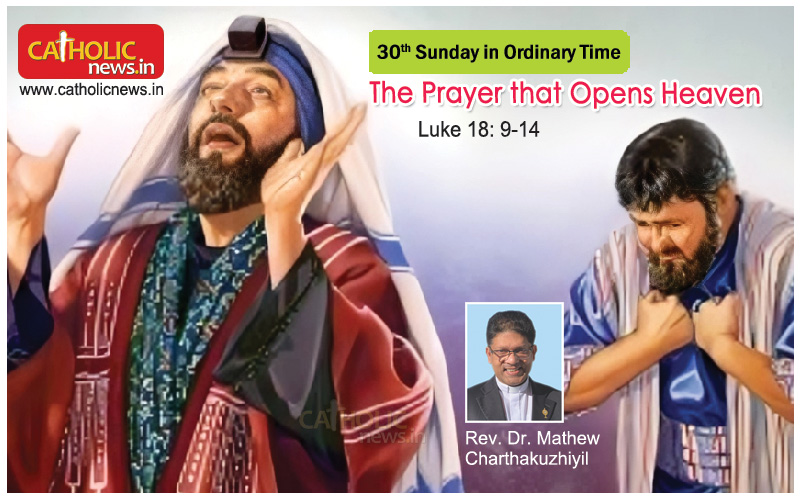
In today’s Gospel, Jesus tells a powerful story about two men who go to the Temple to pray – one a Pharisee, the other a tax collector. Both belong to the same community, both stand in the same sacred space, and both address the same God. Yet when they leave, only one of them is justified in the sight of God. This parable goes straight to the heart of the Christian life, showing us that God listens not to the proud lips but to the humble heart.
The Pharisee is a deeply religious man. He is disciplined, sincere, and faithful to the Law. He fasts twice a week, gives tithes, and observes every commandment. Outwardly, he is a model believer. But his prayer reveals something tragic: he trusts not in God’s mercy but in his own virtue. Standing proudly in the Temple, he recites his goodness before God, thanking him that he is not like other people — especially not like the tax collector standing behind him. His heart is full, but full of himself. There is no space left for grace to enter.
The Pharisee’s mistake is subtle yet fatal. He measures holiness by comparison with others instead of by the holiness of God. His prayer is a monologue of self-congratulation. He looks down on others and lifts himself up, forgetting that true prayer always bows low before the Lord. St. Augustine once wrote, “God is high, but He looks upon the lowly; He knows the proud from afar.” Pride builds walls, but humility opens the door to God’s presence.
The tax collector stands far off, perhaps still smelling of the marketplace, his head bowed in shame. His life is broken – marked by sin, compromise, and guilt. He cannot even raise his eyes to heaven. Yet his few words – “God, be merciful to me, a sinner” – contain more faith and honesty than a thousand eloquent speeches. In that simple cry lies the essence of prayer: truth spoken in humility. He does not justify himself; he simply entrusts himself to God’s mercy. And that is enough.
The difference between these two men is not in their sins but in their hearts. The Pharisee carries his pride into the Temple and goes home unchanged. The tax collector carries his sin into the Temple and goes home forgiven. The Pharisee’s prayer rises no higher than his own lips; the tax collector’s prayer pierces the heart of God. We, too, have come to this house of prayer – not to display our goodness but to receive God’s mercy. Each of us carries burdens, wounds, and failures that only God can heal. The Eucharist is not a reward for the perfect but nourishment for those who hunger for grace. When we approach the altar with humble hearts, we find ourselves lifted up by God’s compassion.
Humility does not mean thinking less of ourselves, but thinking of ourselves less – making room for God and for others. The more we recognize our need for mercy, the more capable we become of showing mercy. When we stop judging others, we begin to see the world through the eyes of God, who loves both the Pharisee and the tax collector, both the righteous and the sinner.
Let us, then, learn to pray like the tax collector. Let our words be few but sincere, our hearts contrite and open. True prayer begins when the mask falls and the soul stands bare before God. The holiest posture is not standing tall but kneeling low. The most powerful prayer is not, “Lord, I thank you that I am not like others,” but, “Lord, have mercy on me.” At the end of the parable, Jesus gives us the key to the Kingdom: “Whoever exalts himself will be humbled, and whoever humbles himself will be exalted.” May this truth echo in our hearts each time we come before the Lord. May our prayer rise from the depths of humility, so that when we leave this church, we too may go home justified — at peace, forgiven, and free.
Fr. Mathew Charthakuzhiyil