
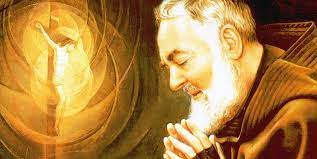
The Italian Franciscan priest St. Pio of Petrelcina, better known as “Padre Pio” and known for his suffering, humility and miracles.
Francesco Forgione was born to his parents Grazio and Maria in 1887. His parents had seven children, two of whom died in infancy. They taught the five surviving children to live their faith through daily Mass, the family prayer of the rosary, and regular acts of penance.
At a young age, Francesco decided to dedicate his entire life to God. At age 10, he felt inspired by the example of a young Capuchin Franciscan, and told his parents: “I want to be a friar – with a beard.” Francesco’s father spent time in America, working to finance his son’s education so he could enter the religious life.
On Jan. 22, 1903, Francesco donned the Franciscan habit for the first time. He took the new name Pio, a modernized Italian form of “Pius,” in honor of Pope St. Pius V. He made his solemn vows four years later, and received priestly ordination in the summer of 1910. Shortly after, he first received the Stigmata – Christ’s wounds, present in his own flesh.
Padre Pio also suffered health problems that forced him to live apart from his Franciscan community for the first six years of his priesthood. By 1916 he managed to re-enter community life at the Friary of San Giovanni Rotondo, where he lived until his death. He handled many duties as a spiritual director and teacher, covering for brothers drafted into World War I.
Against his own wishes, the friar’s reputation for holiness, and attending miracles, began to attract huge crowds. Some Church officials, however, denounced the priest and had him banned from public ministry in 1931. Pope Pius XI ended the ban two years later, and his successor Pius XII encouraged pilgrimages to Padre Pio’s friary.
Padre Pio died in 1968 and was declared a saint in 2002. Three years after his death, Pope Paul VI marveled at his simple and holy life in an address to the Capuchin Order.