



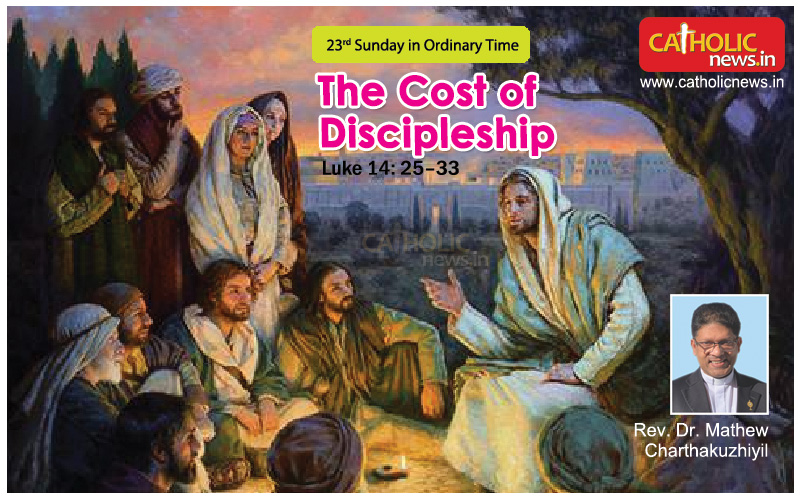

In today’s Gospel, St. Luke presents Jesus as a teacher who is accompanied by a large crowd. He is teaching while on his journey to Jerusalem. The people recognized that there was not only something new and different in his teaching but also a unique authority. His divinity became evident to them through the many miracles he performed—healing the sick, casting out demons, feeding the multitudes, and even raising the dead. Even the Apostles, who followed Jesus closely and continuously, were in what we might call the “school of theology”—learning from his words, but just as much from his actions. For the disciples, the most authentic way to live as Christians was to imitate Christ in everything.
However, the content of today’s Gospel is particularly challenging, especially when we try to understand it from a modern perspective. Jesus says that one must “hate” one’s own father and mother, wife and children, brothers and sisters—and even one’s own life—in order to be his disciple. This is jarring to hear, especially since we are always taught that the heart of the Gospel is love: love of God and love of neighbor. So, why would Jesus speak in such strong and seemingly contradictory language?
To understand the deeper meaning of this passage, we must take into account the historical and social context in which early Christians lived. Christianity was a forbidden and persecuted religion in the Roman Empire until Emperor Constantine granted religious freedom through the Edict of Milan in 313 AD. When St. Luke wrote his Gospel, sometime after the destruction of the Temple in Jerusalem in 70 AD, Christians were already enduring severe persecution. Many believers were rejected or by their own families because of their decision to follow Christ. So, this Gospel passage would have been a powerful source of consolation and encouragement for them. In their experience, Jesus’ words were not just metaphorical—they were literally fulfilled in their lives.
At the conclusion of today’s reading, Jesus declares: “In the same way, any one of you who does not renounce all his possessions cannot be my disciple” (Luke 14:33). This radical demand—the cost of discipleship—caused many people to turn away from Jesus. He had many followers when he worked miracles and offered hope. But most of them abandoned him when he began to speak of the Cross. Authentic discipleship demands more than admiration; it requires a transformation of life. Our identity as Christians should gradually shape us into the image of Christ. Discipleship is not merely a one-time declaration of faith, but rather a daily commitment to live according to the values of the Gospel with purpose and conviction.
Dear sisters and brothers in Christ, each of us is invited to make a choice in following Jesus. A radical choice for Christ often requires radical renunciations. If St. Francis of Assisi had not given up his wealth, privilege, and family attachments in order to follow Jesus more closely, we might never have heard of him as “the second Christ.” He inspires us because of the radical freedom with which he loved Christ above all else. Today, each one of us is called to bring Christ into our homes, our families, and our wider communities. Faith is not meant to remain hidden or private; it must be lived, practiced, and joyfully shared. Let us begin by speaking with those around us about the hope and joy of being Christian. In doing so, we gradually become true missionaries of the Gospel. And one day, we too will share in the eternal reward prepared for those who have loved and served Christ faithfully.
Fr. Mathew Charthakuzhiyil