



An Easter morning in the 1900s. The Russian King Alexander III was confused of a problem. The ministers never met Alexander like this. One of the ministers wanted to know the problem of their king because he saw the king sitting there when there was no war or other attacks.
The king said; He wants to give an Easter gift to his beloved wife. Finally, the king himself had found a solution. He had decided to give her an egg. Carl Faberg, a jeweler, was hired to make the egg in an amazing way. Then the jeweler made the eggshell white and the inside was gold. The inside was filled with the shape of a golden rooster. Its eyes were with diamonds. Inside the chicken was a small gold crown. That egg was so beautiful.
The king said that an egg should be made every year to give to the queen for Easter as an Easter gift. Any method or model can be created. But the king said that every egg should contain something surprising.
In the following years, an amazing egg was made of solid silver. It had the Trans-Siberian train rail. It was a design of the railway line. Stations were marked with precious gems. There was also a gold train inside. Other similar eggs were made by Faberg for the Russian royal family, especially as a gift to other kings. They were all very valuable. They are now in large museums. This is how the concept of ‘Easter egg’ was introduced in Russia.
In Europe, Easter was celebrated with colorful eggs used for home decoration. In Eastern European countries, it was different. In countries such as Hungary and Romania, wooden eggs are beautifully painted in a variety of patterns. Those models had special names and meanings that helped to tell the story of Easter.
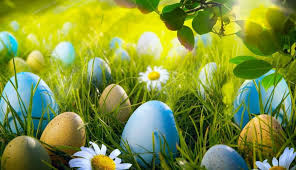
In some other countries, Easter had a special significance. There, there was an ‘egg discovery’ competition. Eggs can be hidden around (inside) a house or garden. Kids need to figure it out. Sometimes they are told that the eggs are hidden by the Easter bunny.
Egg-rolling competitions are held all over the world on Easter Monday. The eggs are laid down on a hill or slope. The winner will be the one whose egg reaches the bottom without breaking. In countries such as France, Germany, Norway, and Syria, egg-laying games are practiced. It is played with boiled hard-boiled eggs. The other eggs should hatch but look after their own eggs without hatching. In the end, the winner is the one with the whole egg in hand.
Rabbits, eggs and chicks are associated with Easter. This is because in pagan times they were seen as symbols of fertility and new life. The early Christians took up the thought or meaning of the new life, because it helped them to remember the resurrection, the new life, and the receiving of it through Christ. Today, Instead of wooden eggs, chocolate eggs are more popular