



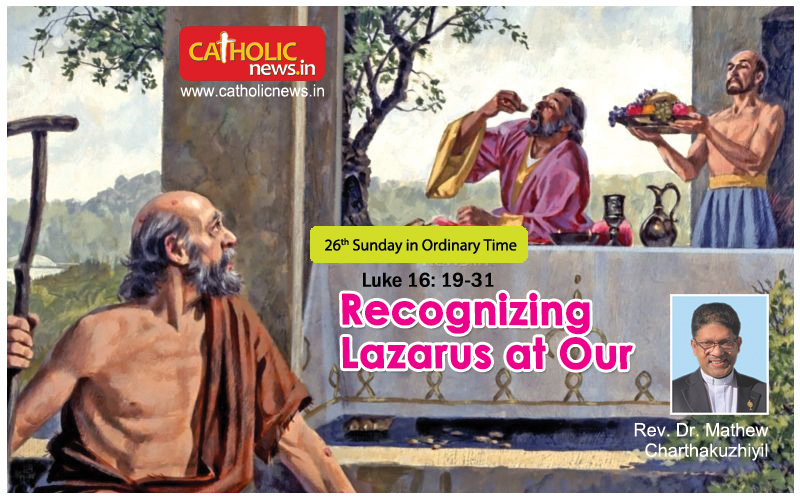
In today’s Gospel, Jesus tells one of his most striking and unsettling parables—the story of a rich man and a poor man named Lazarus. The rich man lives in luxury every day, dressed in purple and fine linen. At his gate lies Lazarus, hungry, covered in sores, hoping for scraps of food. But no help comes. Then, suddenly, the story shifts: both men die. Lazarus is carried by angels to Abraham’s side, while the rich man finds himself in torment. Their positions are reversed for eternity.
This parable is not merely a warning about wealth or poverty. It’s a revelation about how we live in relation to others—and especially to those in need. One detail stands out: the rich man is never given a name. He could be anyone. But the poor man is named Lazarus—meaning “God is my help.” In Jesus’ time, names held deep meaning. To name the poor man is to restore his dignity, to affirm his identity before God. The rich man is nameless because he has lost his sense of relationship—with God and with others. The rich man’s problem isn’t that he has money—it’s that he doesn’t see Lazarus. He steps over him every day and refuses to act. The rich man is not cruel, violent, or abusive. He fails to recognize the person right in front of him. The tragedy is not his wealth, but his hardened heart.
The parable challenges us to examine our own lives. Who are the Lazaruses at our gates? Maybe they’re not covered in sores or begging for food. Maybe they are the lonely, the forgotten, the immigrant, the elderly, the person whose suffering is hidden behind a smile. They may not ask for help aloud—but their needs are real. The Gospel calls us to open our eyes, hearts, and hands before it’s too late. The reversal at the end of the parable is striking. In life, the rich man enjoyed every comfort, and Lazarus suffered. After death, their situations are entirely reversed. Why? Because in the kingdom of God, justice and mercy are not abstract ideals. They are real. How we treat others has eternal consequences. The chasm between the rich man and Lazarus was not created in the afterlife—it began on earth, in daily decisions not to see, not to act, not to love.
How, then, can we respond? First, by seeing the people around us. Real seeing—not just glancing, but noticing. Every person carries the image of God. The Gospel calls us to become attentive, compassionate, present. We can no longer say, “It’s not my problem.” Because in Christ, every human being becomes our neighbor. Second, by sharing. Our blessings—whether material, emotional, or spiritual—are not ours to keep. They are gifts meant to be passed on. God gives us time, talents, and treasure, not to hoard, but to serve. The measure of a meaningful life is not how much we accumulate, but how much we love. Third, by living with urgency. The parable ends with a plea from the rich man to warn his brothers. But Abraham replies: “They have Moses and the prophets; let them listen to them.” In other words, we already have what we need—Scripture, the Church, the sacraments, the example of Christ Himself. The time to act is now.
Dear friends, our lives are a sacred trust. The poor, the suffering, the overlooked—they are not far away. They are at our gates. May we never walk past them without seeing. May we never forget that in serving them, we serve Christ. Let us pray today for eyes that see, hearts that care, and hands that serve—so that when our time comes, we too may be carried to the embrace of Abraham, and hear the Lord say, “Whatever you did for one of these least brothers of mine, you did for me.”
Fr. Mthew Charthakuzhiyil