



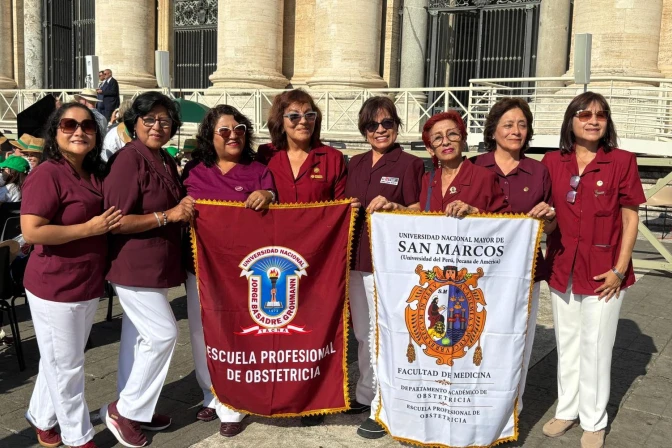
A group of obstetricians from Peru met Pope Leo XIV at the Vatican on Wednesday, June 24, 2026, after the General Audience. The Pope offered words of encouragement for their work in defense of life. “We spent a lot of time with him. He told us that we must persevere, that the important thing is the defense of life,” said Elisabeth Yalán, one of the participants. She noted the Pope’s attention and willingness to listen. “We asked the Holy Father for the blessing we need to continue caring for the life of the mother, the unborn child, and the family.”
The delegation included eight teaching professionals from the National University of San Marcos in Lima and the Jorge Basadre Grohmann National University in Tacna. They represent Peru’s obstetricians’ association, which has some 45,000 members and will mark its 200th anniversary on October 10. When told of the anniversary, the Pope joked in Spanish: “It doesn’t seem like anyone here is 200 years old,” drawing laughter. He welcomed their work as educators. “We need strength and prayer.
As educators, we are working to raise awareness and foster the spirituality that every human being needs, especially in the field of healthcare,” Yalán said.As a gift, the group presented the Pope with a wooden altarpiece crafted by artisans from Ayacucho, a national cultural heritage item. It features the Lord of Miracles and the Virgin of Guadalupe, and depicts a pregnant woman in traditional Andean clothing with her husband, attended by an obstetrician. The piece affirms respect for interculturalism and the defense of the unborn child.Today’s obstetricians trace their roots to French midwife Benita Cadeau de Fesel, who arrived in Peru in 1826 and is considered the pioneer of modern obstetrics in the country. Two centuries ago, childbirth was a leading cause of death for women. The situation has improved but challenges remain. World Bank data from 2023 shows 51 maternal deaths per 100,000 live births in Peru.
Access is especially difficult in remote areas. In the Amazon, reaching a health post can mean crossing the river for six hours, said Mirian Solís Rojas, an obstetrician with 36 years of experience. In hard-to-reach regions, community health workers use makeshift stretchers to carry women to ambulances. “They live in the hills. Our ambulance can’t reach those hills,” said Bertha Sandoval, who works in northern Lima. Cultural barriers also exist. In some native communities, health workers need permission from tribal leaders to enter, which is not always granted. Many women also trust untrained midwives without medical resources, which can be fatal in emergencies. “The moment of greatest risk of maternal death is right after childbirth, due to hemorrhaging,” Solís Rojas explained.
To reduce risks, programs like “waiting homes” bring women near their due date to houses close to maternity centers, especially in the high Andes. “Women who are close to their due date, at least two weeks before, are transferred to homes near the maternity center, respecting their customs,” said Pilar Ordóñez, who has worked directly with this care model. “We are always ready to assist women, listen to them, and help them holistically. We accompany them throughout their lives, building empathy and gaining their trust so we can better support them,” Yalán added.The group recently attended the 34th International Confederation of Midwives congress in Lisbon, themed “One Million More Midwives Today.”
There, they presented their experience integrating Andean worldview into obstetric training. “They consider motherhood as something very sacred, and that is precisely what we want to recover in our societies,” said Jacqueline Flores, who worked five years in rural Huancavelica and La Libertad without electricity or water. “I combined my knowledge with the traditions of the community and was able to save the lives of many patients.”For the past four years, they have run a program sending about 50 students annually from Tacna to Cusco, on a 20-hour journey, to learn culturally appropriate care in Yanahuara. Local midwives teach ancestral knowledge alongside modern practice. “They learn not only traditional techniques, but also a holistic approach to care,” Flores said. The role of obstetricians today, they emphasized, covers sexual and reproductive health, prevention, management, and research, with active participation in high-risk obstetric