



St. David, Welsh Dewi, was born in the 520 century, near St. Bride’s Bay, Pembrokeshire. He is the patron saint of Wales.
He was the son of the chieftain Sant, who raped David’s mother, St. Non. Educated at Henfynyw, Cardigan, he seemingly took a prominent part in the synod of Llanddewi-Brefi (in Cardigan) to suppress the heresy of Pelagius and presided at the Synod of Victory held later at Caerleon-on-Usk, Monmouthshire, which supposedly defeated the Pelagian heresy in Britain. More certainly, he moved the seat of ecclesiastical government from Caerleon to Mynyw, which is, as St. David’s (Ty-Dewi), still the cathedral city of the western see.
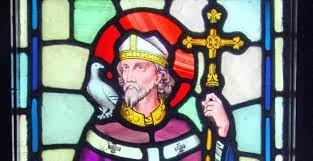
Many miracles are ascribed to St. David, including the resurrection of a dead child and the restoration of sight to a blind man. One of the more famous miracles associated with him is the formation of a hill beneath him as he preached to a large crowd, allowing them to see and hear him more clearly. During this incident, a white dove is said to have landed on his shoulder, and St. David is often so depicted.
David founded numerous churches throughout South Wales (more than 50 named for him existed in the 21st century). His shrine at St. David’s became a notable place of pilgrimage, especially during the Middle Ages. His canonization by Pope Calixtus II (c. 1120) is unproven. His feast day, known as St. David’s Day, is widely celebrated in Wales, and many people wear traditional Welsh clothing and daffodils or leeks in commemoration.