




“A guest in the house – God in the house” is a Polish proverb. A similar proverb exists in India in the Hindu holy scriptures, where it says: “respect guests as God.” Hospitality is the theme of the first reading and of the Gospel reading. As we heard in the first reading God visited Abraham as an unexpected guest. Abraham welcomed him very warmly.
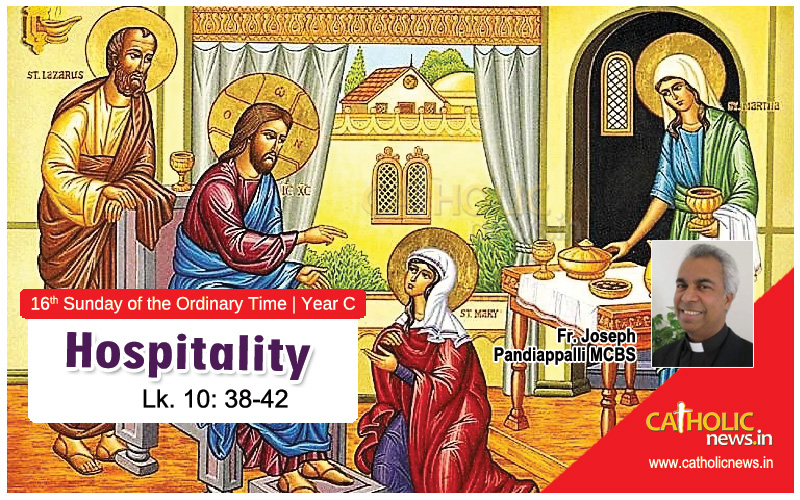
In the Gospel reading from the Gospel of Luke Jesus is a guest of Martha and Mary. Mary and Martha greeted and welcomed Jesus very warmly. Martha was very friendly and immediately began doing various preparations, such as cooking, setting the table etc. But Mary took the opportunity to stay with Jesus and talk with him. One does the work, and the other takes care of the guest. It is actually a good division of responsibility. That’s how one could understand it. Today, it would also be conceivable in some countries to cook together with the guest which is considered as an honour. But the situation here is different. Martha feels lonely and neglected. She wanted Mary to help her. Perhaps she wanted to prepare together with Mary. But Jesus said that Mary has chosen the better option.
When we hear this story, it could be interpreted that sitting at the table with the guest, talking to him, or going for a walk together with the guest are more valuable than all the preparations for a guest. If no one was willing to wash, clean, cook, and arrange things, welcoming a guest would hardly be possible. Sitting with the guest alone would not help to show hospitality. Therefore the words of Jesus be understood properly. Jesus is not valuing one task over the other. Jesus is saying that Martha who was unnecessarily worrying and trying too hard to arrange things for the guest.
Jesus told Martha that Mary had chosen the better option. It would give the impression that being with Jesus was more valued than preparing to treat Jesus. But in the same Gospel, we read about the Good Samaritan, who cared for the helpless. He was described as the neighbour, rather than the priest and the Levite, who considered their services and rituals more important than taking care of an abandoned man on the street. Therefore, Jesus is not saying that listening and sitting together is better than preparations or work. Jesus says only that it is unnecessary to worry and exert oneself too much when receiving guests or when receiving Jesus. As a guest, Jesus does not expect a five-star menu. He is there within the given opportunity to spend time with the host. It means also that we can receive a guest within the given opportunities without too much worry.
Receiving a guest can also be simple and humble. Similarly we can welcome Jesus in a more simple and humble manner. A guest does not necessarily come to be served, but to be with the host through his presence. In the book of Genesis we read that Abraham welcomed his unexpected guests warmly and was richly blessed. God blessed him with the blessing of a son which was the fulfillment of his life’s desire. Martha and Mary welcomed Jesus warmly and were thus richly blessed. When their brother died, Jesus raised him from the dead.
Abraham’s guests were not from his circle of friends or acquaintances, but rather, they were initially strangers to him. Unexpected guests, or even strangers can sometimes bring blessings. Whenever a guest is received, the hosts are usually more blessed than the guest themselves. As Jesus visited Martha and Mary these both women were blessed through Jesus. Jesus was reminding Martha not to be worried about preparations, but be happy about the blessings of the visit of Jesus. The same is with every guest. Host needs primarily to be happy and grateful for the blessings the guests bring.
Fr Joseph Pandiappallil MCBS