



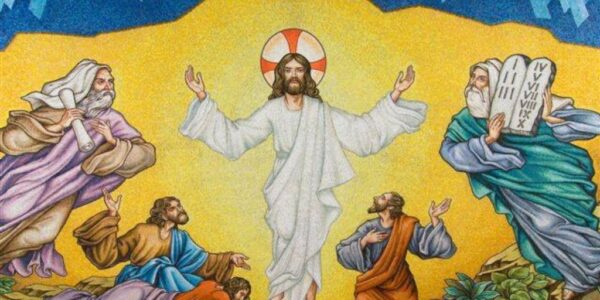
On August 6, Catholics celebrate the Solemnity of the Transfiguration of the Lord, a moment shortly before his Passion, in which he is transfigured before three of his disciples on Mount Tabor.
Below, we share eight facts that every Catholic should know about this event.
1. Transfiguration means “change of form”
The word “transfiguration” comes from the Latin roots trans (“through”) and figura (“shape, aspect”). Therefore, it signifies a change of form or appearance.
This is what happened to Jesus in the event known as the Transfiguration: His appearance was changed and he became glorious.
2. The Gospel of Luke predicts the Transfiguration
In the Gospel of Luke 9:27, at the end of a speech to the twelve apostles, Jesus mysteriously adds: “Truly I tell you, there are some among those present here who will not taste death until they see the Kingdom of God”.
This has often been taken as a prophecy that the end of the world would occur before the first generation of Christians died. However, the phrase “kingdom of God” can also refer to “the outward expression of the invisible kingdom of God.”
The kingdom is embodied in Christ himself and could therefore be “seen” if Christ manifested it in an unusual way, even in his own earthly life, just as the event of the Transfiguration was.
Pope Emeritus Benedict XVI claimed that Jesus “convincingly argued that the placement of this saying immediately before the Transfiguration clearly relates him to this event.”
“Some, that is, the three disciples who accompany Jesus up the mountain, are promised that they will personally witness the coming of the Kingdom of God ‘in power,'” he added.
3. The Transfiguration was Witnessed by the Three Main Disciples
The Transfiguration occurred in the presence of the apostles John, Peter, and James, the three main disciples.
The fact that Jesus only allowed three of his disciples to witness the event may have sparked the discussion that quickly ensued over which of the disciples was the greatest (Luke 9:46).
4. The place where the Transfiguration Occurred is not Exactly Known
St. Luke states that Jesus took the three up to “the mountain to pray.” This mountain is often thought to be Mount Tabor in Israel, but none of the gospels accurately identifies it.
5. The Transfiguration Served to Strengthen the Faith of the Apostles
According to the Catechism of the Catholic Church: “The purpose of the Transfiguration of Christ is to strengthen the faith of the apostles in view of the proximity of the Passion: the ascent to a ‘high mountain’ prepares the ascent to Calvary. Christ, Head of the Church, manifests what his body contains and radiates in the sacraments: ‘The hope of glory’”.
6. The Gospel of Luke is the one that Gives more Details of this Event
Saint Luke mentions several details about the Transfiguration that other evangelists do not.
For example, note that this happened while Jesus was praying; he mentions that Peter and his companions “were asleep and when they awoke they saw the glory of him and the two men who were with him.”
He also mentions that Peter suggested putting up tents while Moses and Elijah left.
7. The Appearance of Moses and Elijah Represent the Law and the Prophets
Moses and Elijah represent the two main components of the Old Testament: the Law and the Prophets. Moses was the giver of the Law and Elijah was considered the greatest of the prophets.
8. Saint Peter’s Suggestion was Wrong
The fact that Peter’s suggestion occurs as Moses and Elijah are preparing to leave reveals a desire to prolong the experience of glory. This means that Peter is focusing on the wrong thing.
The Transfiguration experience is meant to point to the sufferings that Jesus is about to experience. It is meant to strengthen the faith of the disciples, revealing to them the divine hand that is at work in the events that Jesus will undergo.
Peter misses the point and wants to stay on the mountain, contrary to the message that Moses and Elijah have been expounding.
As an apparent rebuke of this, a theophany occurs: “A cloud came and overshadowed them, and they were afraid when they entered the cloud. And a voice came out of the cloud, saying: ‘This is my Son, my Chosen; Listen to him!’”
(Originally published on the National Catholic Register.)