



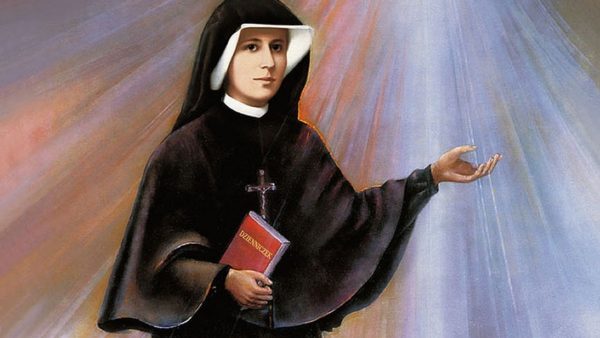
Maria Faustyna Kowalska ,Helena Kowalska also known as Saint Maria Faustyna Kowalska of the Blessed Sacrament and popularly spelled Faustina, was a Polish Roman Catholic nun and mystic. Her apparitions of Jesus Christ inspired Roman Catholic devotion to the Divine Mercy and earned her the title of “Secretary of Divine Mercy”.
Throughout her life, Kowalska reported having visions of Jesus and conversations with him, which she noted in her diary, later published as The Diary of Saint Maria Faustina Kowalska: Divine Mercy in My Soul. Her biography, submitted to the Congregation for the Causes of Saints, quoted some of the conversations with Jesus regarding the Divine Mercy devotion.
Faustina was born on August 25, 1905, in the village of Lodz, Poland. She has lived in this world for only 33 years, having to go through a lot of hardships. Pope John Paul II called her the ‘leading apostle of the twentieth century’, who never left the convent for missionary work. Faustina, who received only a basic education, was greatly influenced by the Divine Mercy, the Sacred Heart, the devotion to the Mother, and later the Catholic Church acknowledging and giving the Feast of God’s Mercy through her. Along with the love of God, the missionary zeal to win souls for heaven and the love of being cut off and losing one for the sake of others were evident in Faustina from an early age. She later sacrificed her life for sinners.
On September 13, 1935, Jesus revealed to Faustina a powerful way to receive God’s grace for the world. He showed her the wound in his heart. The Sacred heart of Jesus is the source of the great pool of mercy that has been poured out on mankind. From that sacred heart, Faustina saw two kinds of light flowing, illuminating the world. Jesus Himself explained to her about the rays. These two rays represent blood and water.
Blood symbolizes the sacrifice on the cross and the gift of divine grace. The water symbolizes the baptism of John and the gift of the Holy Spirit. God’s grace reaches people through the heart of the crucified Christ. Jesus told Faustina, “My daughter, tell the world that I am the embodiment of love and compassion. Peace will not be found until mankind retreats in hope of God’s mercy. ”
The next day, when Faustina was entering the Chapel, she heard an inner voice, ‘The prayer I taught you yesterday. Pray every day as you enter the chapel.’ When she prayed for it, she heard the voice again, ‘This prayer is able to soothe my anger. You must recite it in the rosary for nine days’. Jesus asked her to start this compassionate movement in her community and to spread it all over the world. Pope John Paul II often reminds us to turn to God’s grace in search of answers to the specific problems of our time.
Later in 1936, Faustina became ill due to tuberculosis. She continued to spend much time in prayer reciting the chaplet and praying for the conversion of the sinners. She died on 5 October 1938, at the age of 33 in Krakow. She was beatified on 18 April 1993 by Pope John Paul II. She was canonized on 30 April 2000 and her feast day is October 5. The major shrine is the Basilica of Divine Mercy, Krakow, Poland.