



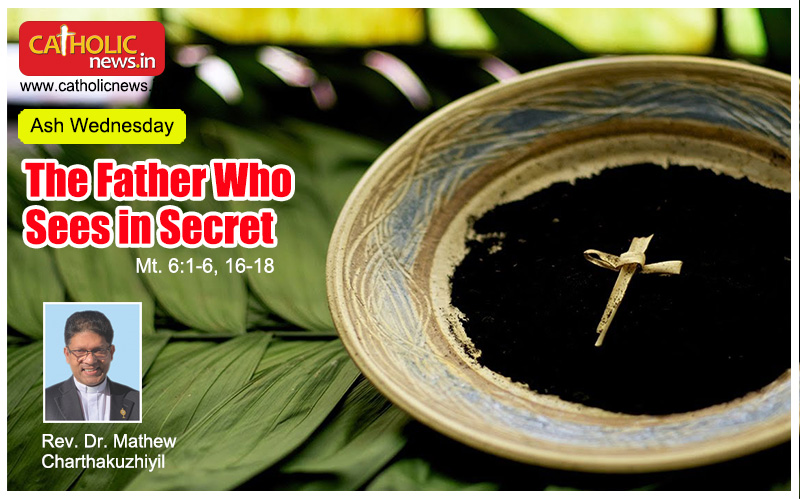
Today we begin Lent with ashes on our foreheads and the quiet words: “Remember that you are dust, and to dust you shall return.” These ashes are visible, yet the Gospel speaks about what is hidden. Jesus warns us not to practice our righteousness in order to be seen by others. Prayer, fasting, and almsgiving are not meant to be performances. Lent begins by shifting our focus from the outer appearance to the inner heart. The ashes humble us; they remind us that we are fragile, dependent, and passing through this world. But they also remind us that we belong to God. When everything superficial is stripped away, what remains is our relationship with the Father. The ashes place us in truth — small before God, yet deeply loved.
In the Gospel, one phrase repeats like a refrain: “Your Father who sees in secret.” That is the heart of today’s message. God sees what others do not see. He sees the silent prayer whispered before sleep, the struggle against temptation, the act of forgiveness that costs us pride, the generosity given quietly without recognition. So much of what is most important in our spiritual life is hidden. The world values what is public and visible; Jesus values what is faithful and unseen. Lent invites us to rediscover this hidden dimension of faith. We do not pray to impress, but to encounter. We do not give to be admired, but to love. We do not fast to appear strong, but to become free. The Father sees not only our actions but our intentions. And his gaze is not harsh or critical; it is the loving gaze of one who desires our healing.
“When you pray,” Jesus says, “go into your inner room and close the door.” The inner room is the heart. Many of us live busy lives, filled with responsibilities, conversations, decisions, and constant noise. Even our minds rarely rest. Lent invites us to close the door for a few moments each day and simply be present before God. Not to say many words, not to accomplish something, but to listen. In silence we rediscover who we are: not performers, not achievers, but children. In that quiet space, we allow God to examine our hearts, to reveal what needs to change, and to strengthen what is weak. Prayer during Lent is less about speaking and more about surrendering. It is learning again to trust the One who gives us life and who holds our future.
Jesus also speaks about fasting and tells us not to look gloomy. True fasting is not about sadness but about freedom. When we fast, we create space. We step back from what fills us so that God can fill us more deeply. Fasting may involve food, but it can also mean fasting from anger, from constant distraction, from unnecessary words, from habits that keep us from love. It is an act of discipline that strengthens the soul. Almsgiving, too, is more than giving money; it is offering mercy, time, patience, and compassion. The ashes remind us that one day we will leave everything behind. What will remain is love. Lent trains our hearts to invest in what endures beyond dust.
As we begin these forty days, we do not aim at perfection but at sincerity. The ashes will fade from our foreheads, but the call to conversion remains. Lent is not about dramatic gestures; it is about steady, hidden faithfulness. The Father who sees in secret walks with us. He is patient with our weakness and generous with his grace. Today we stand before him as dust — fragile, limited, and mortal — yet also as beloved children. If we allow him to work within us quietly through prayer, fasting, and charity, these forty days will lead us gently toward Easter. And when the light of the resurrection dawns, we may discover that what was done in secret has quietly transformed our hearts.
Fr. Mathew Charthakuzhiyil