



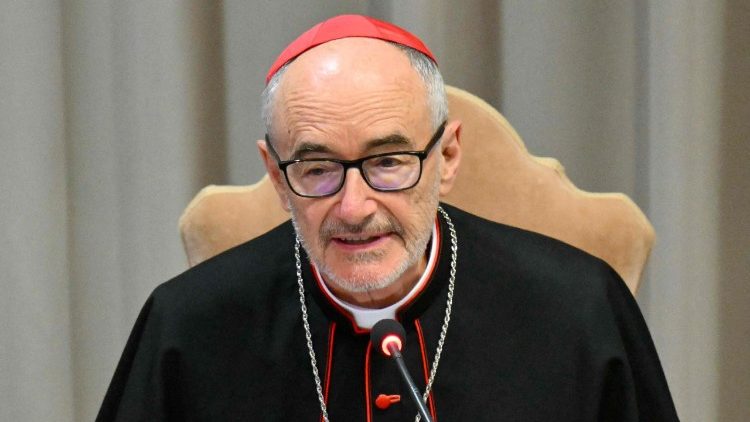
During an event in Sofia, Bulgaria, on November 17, Cardinal Michael Czerny, SJ, emphasized that humans must remain directly accountable for the violence and destruction unleashed by modern technologies. Speaking at a gathering co-hosted by the Bulgarian Academy of Sciences and the Apostolic Nunciature, the Prefect Emeritus of the Dicastery for Promoting Integral Human Development presented Pope Leo XIV’s first encyclical, Magnifica humanitas, focusing heavily on the ethics of war and peace. Cardinal Czerny stressed that decisions involving lethal force must never be ceded to machines, insisting that it must always be possible to identify the specific individuals responsible for them.
To frame the moral challenges of artificial intelligence, the Cardinal contrasted two biblical construction projects: the Tower of Babel and the rebuilding of Jerusalem. While the builders of Babel possessed skill and unity, their desire for absolute control led to division and failure. Conversely, those rebuilding Jerusalem succeeded because each family took responsibility for their section while trusting in God and relying on one another. Cardinal Czerny noted that the underlying intent separates the two outcomes, posing the same critical question to today’s AI developers and users regarding the kind of civilization their tools are helping to construct.
Addressing the modern realities of armed conflict, Cardinal Czerny echoed Pope Leo XIV’s view that the traditional “just war” theory is outdated, warning that the concept is too frequently misused to justify aggression with increasingly destructive weaponry. While the Pope upholds the strict right to self-defense, he advocates for dialogue, diplomacy, and forgiveness over military escalation. The Cardinal highlighted the encyclical’s warning against a “culture of power” that treats war as inevitable, dismisses peacebuilders as unrealistic, and ignores human suffering in favor of strategic interests.
Outlining the ethical guardrails required for artificial intelligence in combat, Cardinal Czerny pointed to three specific criteria established by Pope Leo. First, an identifiable and verifiable chain of responsibility must exist, stretching from the engineers who design and train the AI to the commanders who deploy it. Second, human operators must be given sufficient time to exercise moral judgment, ensuring that sheer speed and efficiency do not dictate irreversible lethal actions. Third, combatants must always be clearly distinguished from civilians so that non-combatants and vital survival infrastructure remain protected.
Concluding his reflection, Cardinal Czerny noted that the pursuit of peace begins on a deeply personal level rather than solely on the international stage. Referencing Pope Leo’s appeal for a “disarmament of heart, mind and life,” he reminded the audience that everyday words and images also carry the potential to inflict harm. Ultimately, the Cardinal asserted that the origins of both conflict and harmony lie within the individual, calling on everyone to pacify the hostility within their own hearts.