



When Jesus called Matthew from the customs post, he saw more than an unpopular tax collector. He saw someone who could become his disciple. Others judged Matthew by his work, but Jesus offered him a new beginning. This helps us understand today’s Gospel. We should not judge people only by their mistakes. God’s grace can help them change. Matthew’s Gospel presents Jesus as the promised Messiah, descended from Abraham and David. It also reminds believers facing difficulties that they are not alone. Jesus, who called Matthew to follow him, calls us to belong to a community where we speak the truth with love and offer one another mercy. Each of us needs that mercy. We have all said something unkind, misunderstood someone, or failed to help. Remembering our own weakness makes us more patient with the weakness of others.
One message runs through Matthew’s Gospel: God is with us. At the beginning, Jesus is called Emmanuel, meaning “God with us.” At the end, he promises to remain with his disciples always. Today he says: “For where two or three are gathered together in my name, there am I in the midst of them.” Jesus gives this promise after explaining how to deal with disagreements. He is present not only when everyone gets along, but also when we struggle to understand one another. He is with us when we begin a difficult conversation, say sorry, or try to rebuild trust. We do not have to solve every problem before turning to him. We need his help because we cannot heal every broken relationship alone.
Jesus gives a simple instruction: speak to the person privately. Often, we do the opposite. Instead of speaking to someone who has hurt us, we tell everyone else. A disagreement becomes gossip, and more people get hurt. Saint John Chrysostom explains this Gospel using the example of a doctor: “For the physician in like manner, when he sees the malady obstinate, does not give up nor grow impatient.” A good doctor remains patient when an illness is difficult to treat. In the same way, correcting someone should be about helping, not humiliating. Before speaking, let us ask: Do I want to help this person, or simply prove that I am right? Am I willing to listen? Love takes wrongdoing seriously, but seeks to heal rather than hurt.
Making peace does not mean ignoring wrong actions. Jesus says that others, and eventually the community, may need to help when a private conversation fails. His words must never be used to hide abuse or force someone to remain in danger. Protecting people and asking for help are acts of love. Sometimes we need firm boundaries, but we must not let hatred rule our hearts. Remember Matthew: Jesus called someone whom others rejected. We can say no to harmful behaviour while still praying that a person will change. Forgiveness does not always restore trust immediately. Trust grows through honest words and changed behaviour over time. Our Church must be a place where truth is spoken, wrongdoing is addressed, and mercy remains possible.
Let us welcome Christ into one relationship. We might say sorry, listen more carefully, or ask for help. At home, let us pray together, even if there are only two of us. Prayer is not about asking God to prove us right. It is about allowing him to change our hearts. A family prayer can be very simple: thank God for one blessing and ask his help with one difficulty. Such moments remind us that we face life together, not alone. At the Eucharist, Jesus gathers us as one family. Let us pray: Lord Jesus, stay with us. Help us speak honestly, listen patiently, and forgive generously. Make our homes and our parish places where people find protection, kindness, and hope.
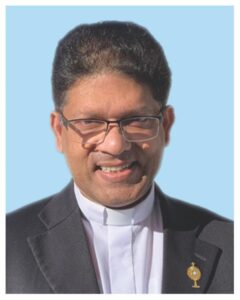
Fr. Mathew Charthakuzhiyil