



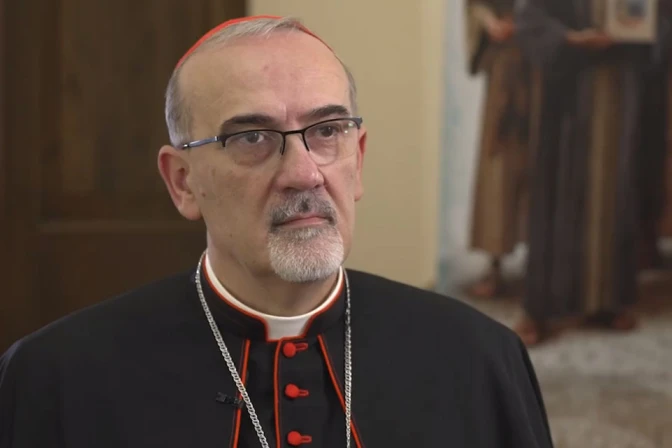
Cardinal Pierbattista Pizzaballa, the Latin Patriarch of Jerusalem, described Gaza as “a disaster” after a recent visit to the Strip, urging the world not to abandon the Holy Land. He made the remarks on Monday, June 29, in Bergamo, Italy, after receiving the Limes Prize for Dialogue and Peace from the Italian geopolitical magazine Limes.“There is a need for empathy toward those who do not think as we do,” Cardinal Pizzaballa said during his conversation with Limes editor-in-chief Lucio Caracciolo.
He spoke of his June 22–23 visit to Gaza alongside Theophilos III, the Greek Orthodox Patriarch of Jerusalem.“The cities have been razed to the ground, leveled, wiped out. Rafah no longer exists. What strikes me most is traveling along makeshift roads, through tents and sewage. This is where the people of Gaza live,” he said. “One thing the images do not convey is the smell. And one of the greatest scourges right now is the rats, which bite. They bite children above all, and Gaza is full of children — you see them everywhere, but instead of going to school, they play, dirty, beside the sewers.”The situation has not improved even after the ceasefire, the Patriarch noted. “While some food is now able to enter, almost everything else is still prohibited.
Dual-use goods are not allowed in. And by dual-use they even mean school desks, pencils, notebooks, and the glass needed for windows. We want to reopen the schools, but we are missing almost everything. We try to make do by recycling whatever pieces we can find here and there.”Healthcare workers told him that trained staff are urgently needed to address psychological trauma among children and mothers. “This is an issue that must be handled with the sensitivity it deserves. I’ll say it in a not-very-diplomatic way, but I feel profound sorrow. I just can’t understand,” he said.
Meanwhile, reports emerged of an Israeli airstrike that destroyed dozens of tents sheltering displaced Palestinian families in a densely populated area. Women, children, and people with disabilities were forced to spend the night outdoors. Eight people were reportedly killed in central and southern Gaza, while two more died north of Khan Younis in a drone strike.Cardinal Pizzaballa said conditions are equally dire in the West Bank. “There is no rule of law,” he said. “The law does not apply, and even if it does, it is not meant for Palestinians. Israeli settlers are allowed to do anything.
They set up checkpoints everywhere, cut down trees, and prevent people from cultivating their land. Assaults, thefts, and insults have become everyday occurrences.” He added that such incidents often go unpunished: “We often call the Israeli army to intervene and restrain the settlers, but by the time they arrive, the settlers have already left — as though someone had warned them — and so the IDF ends up taking it out on us.”Despite the destruction and violence, the Cardinal stressed the necessity of dialogue. “October 7 remains deeply present in the Jewish and Israeli psyche. Since that day, the last restraints have fallen away,” he said. He described Israel today as “a mix of things,” but noted with regret that “the most hardline are the religious military.” “It’s very difficult to have a clear and serene relationship with them,” he said. “The most extreme elements of the Jewish population are not yet in the majority, but they are gaining support and becoming increasingly influential politically, with consequences that are, however, divisive for Israeli society itself.”Limes editor-in-chief Lucio Caracciolo referenced former Israeli President Reuven Rivlin’s 2015 idea of Israeli society divided into “tribes” — secular Zionists, religious nationalist Jews, the ultra-Orthodox, and Arab Israelis — living largely parallel lives. Cardinal Pizzaballa said this division, along with the growth of the Haredi population, is “fueling uncertainty within Israeli society, while Israel continues to feel surrounded by Arab countries.
This too shapes Israel’s decisions.”Jerusalem is also changing, he said. “It is changing demographically, geographically, but above all in its internal and psychological boundaries. The way people experience the city is changing. Until recently, the Old City of Jerusalem was inhabited predominantly by Arabs. Now it is common to see Jews, including religious Jews, everywhere. The Arab population is growing more slowly, and the Christian community is shrinking.”He added that increased contact is also driving tensions: “The reason why clashes are on the rise is also linked to this: the fact that people are meeting more often and more easily.” He noted that Jerusalem’s Arab community has participated little in recent political developments in Gaza and the West Bank — “not because of a lack of solidarity, but because of strict military control and also to protect what remains of Jerusalem’s unique character. The heart of everything is there.”