



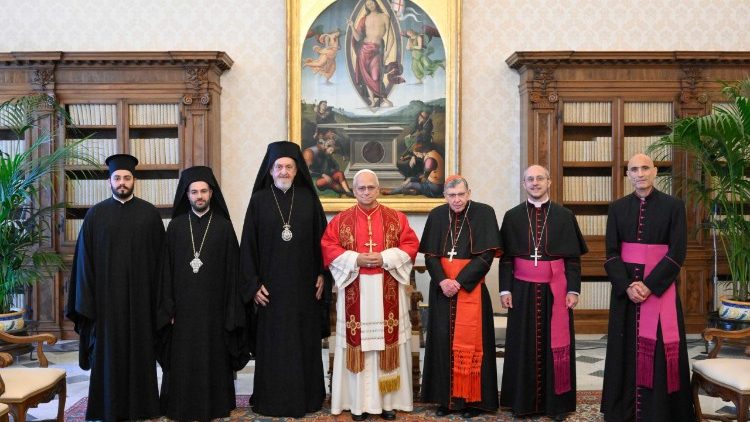
Pope Leo XIV told a delegation from the Ecumenical Patriarchate of Constantinople that all Christians are called to work together toward celebrating the Year 2033, marking 2,000 years since Christ’s Redemption. He made the remarks Tuesday at the Vatican while receiving the delegation for the Solemnity of Saints Peter and Paul.“May the journey towards the celebration of the second millennium of the Redemption, in 2033, be undertaken together by all the Christian denominations of the world, rediscovering the gift and the call to be witnesses to the Risen One,” the Pope said.
Pope Leo expressed delight at welcoming the delegation, saying their presence reflects “the fraternal closeness of our sister Church in Constantinople and of its shepherd and guide, His All Holiness Bartholomew, Ecumenical Patriarch.” He thanked the Ecumenical Patriarch and the Holy Synod for continuing the tradition of exchanging visits on the feasts of their respective patron saints. The Pope recalled participating last year in the Feast of Saint Andrew at the Patriarchal Church of Saint George at the Phanar. He also noted his meetings with Patriarch Bartholomew I, which he said deepened their friendship and allowed greater sharing of views, “above all our common desire to make progress on the path towards full unity amongst all Christians.”Pointing to the 1,700th anniversary of the First Council of Nicaea, commemorated on the eve of the Feast of Saint Andrew in İznik, Pope Leo said the event offered “an eloquent testimony to the communion that already exists amongst those who share faith in God, the Father of all, and who believe in Jesus Christ, as Lord and Son of God, and in the Holy Spirit.”
He underscored that the Nicene Creed “must be the foundation and guiding principle of this ecumenical journey, offering the model of true unity within legitimate diversity: Unity in the Trinity, Trinity in Unity.”“In an age marked by wars and growing polarization, as well as cultural and social divisions,” the Holy Father said, “Christians—reconciled amongst themselves and united in their profession of the one faith—are called to be a credible sign of peace, making a decisive contribution to the efforts of all men and women of good will to build peace.” In the current situation, he added, “it is not only the credibility of the Christian message that is at stake, but the very future of humanity.”
The Pope said the need for greater cooperation among Christians on challenges such as peace, new technologies, and care for creation “stems from the Gospel of Jesus Christ itself.” He stressed that “our responsibility for the life and dignity of every human being, beginning with the youngest and most needy, is the criterion that will determine our present and eternal destiny.”Closing his remarks, Pope Leo thanked the delegation and the Ecumenical Patriarchate for their commitment to promoting Christian unity. “Through the intercession of the holy Apostles Peter and Andrew, brothers in the flesh and in faith, may God our Father accompany us always with His blessing,” he said.