



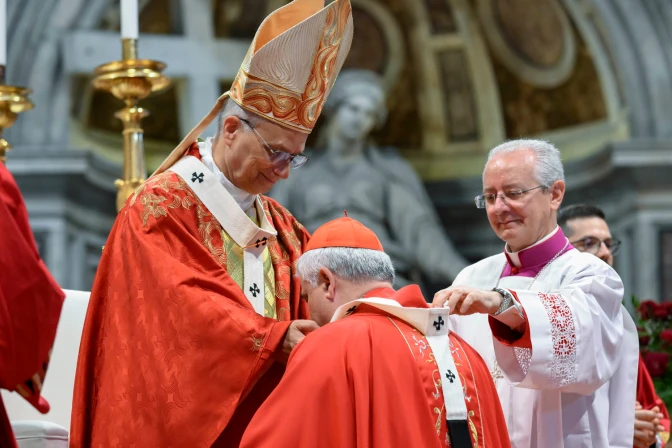
This Monday, June 29, Pope Leo XIV celebrated Mass in St. Peter’s Basilica for the Solemnity of Saints Peter and Paul, whom Catholics venerate as “two pillars of the Church.”
The following is the homily of Pope Leo XIV in the Vatican Basilica:
Dear brothers and sisters:
Today, in a single solemnity, we commemorate Saints Peter and Paul, patrons of the city and diocese of Rome: chosen by Jesus, one as shepherd of his flock and the other as apostle to the Gentiles. In them we venerate two pillars of the Church.
Peter, guardian of the People of God, appears on numerous occasions in the New Testament committed to preserving communion among the brothers. It is he who, on the Sea of Galilee, after a night of seemingly fruitless labor, says to the Master: “We have caught nothing; but at your word I will let down the nets” ( Lk 5:5), and returns to the sea, taking the others with him. It is also he who, while many turn away from the Lord after the harsh discourse on the Bread of Life, says to the Messiah: “To whom shall we go? You have the words of eternal life” ( Jn 6:68), and remains, along with the other eleven. It is still he who, in Caesarea, recognizes Jesus as the Son of God and becomes the spokesperson for all in the profession of the one faith, as we have heard in the Gospel (cf. Mt 16:13-19). Furthermore, after the Resurrection, on the shores of the lake, he is the first to reach Christ, throwing himself into the water and swimming ahead of the others, to humbly renew his love and receive confirmation of his mission (cf. Jn 21:1-17).
Peter remains faithful to this mission, even when, for example, in Jerusalem, the question of admitting uncircumcised Gentiles to baptism threatens to divide the community. He gathers the brothers, listens to them, and, in the end, guided by the Holy Spirit, makes the decision, preserving communion and inaugurating a new stage for all the People of God: “We believe,” he affirms, “that both they and we are saved by the grace of the Lord Jesus” ( Acts 15:11).
This greatness of spirit does not mean that Peter is perfect. During the Passion, he denies the Master, only to later shed sincere tears of repentance (cf. Lk 22:54-62); and Paul himself, on another occasion, reproaches him for the inconsistency of some of his attitudes (cf. Gal 2:11-14). Nevertheless, he knows how to recognize his own errors and repent, without becoming discouraged and without ceasing to fulfill his mission of proclaiming the Gospel and gathering Christ’s flock, even unto martyrdom, which he suffers right here in Rome, not far from where we are now.
This faithful and patient concern for unity is well expressed in the symbol of the keys, with which we often identify it (cf. Mt 16:19). A key is not for breaking down doors, but for opening and closing them, finding the appropriate handles within and guiding their movement, to unblock them, slide the pins, and allow the leaves to turn freely on their hinges, uniting spaces and transforming so many isolated rooms into a single, welcoming home. Similarly, communion in the Church is not built by hardening one’s own positions, but by seeking, in everyone’s hearts, the points of encounter in the Truth, in whose sole light all become instruments of growth for one another.
From this perspective, we could interpret the mission that the Lord entrusted to Peter and his successors, for the benefit of all God’s holy People: to listen, with his help, to the voices of each one; to discern inspirations; to guide the paths; to correct errors; to instruct, encourage, exhort, and accompany our brothers and sisters so that, docile to the action of the same Spirit (cf. 1 Cor 12:1-11), they may cooperate in the salvation of one another and of all humanity. But Peter’s example is also an invitation for every Christian to become an architect of unity, placing God at the center of their existence and drawing near to their brothers and sisters, attentive to their vicissitudes and needs (cf. Francis, Catechesis , October 9, 2024), to live with them in charity and thus “carry out the message of the Gospel” (cf. 2 Tim 4:17).
This is also the teaching of Paul, the other great apostle we celebrate today, a tireless proclaimer of the Good News. He, too, has his distinctive symbols: the book and the sword, closely linked. The author of the Epistle to the Hebrews explains it well when he writes that, “the word of God is living and active, sharper than any double-edged sword,” capable of penetrating “even to the point of dividing soul and spirit” and discerning “the thoughts and attitudes of the heart” ( Heb 4:12).
This is what God accomplished in the heart of young Saul, conquering him (cf. Phil 3:12) and leading him first to conversion to the Gospel, adopting a new name; then to proclaiming it throughout the world; and finally, to bearing witness to it as Peter, in this very city, to the point of giving his life. The Apostle to the Gentiles allowed himself to be transformed by the power of the Word of God, which drew him away from violence and led him along the path of love.
Saint Augustine, commenting on his conversion and mission, said: “When he was on the road to Damascus, snorting threats and death, the heavenly voice called him (cf. Acts 9:1-7), the Word humbled him” (cf. Sermon 299/A Aug., 6). And he added: “He made the persecutor of the Church a preacher of peace, forgave all his sins, and placed him in such a position that, through his person, the sins of others might be forgiven” ( ibid .).
Dear brothers and sisters, today it is important to reflect on these two saints—Peter and Paul—to understand how we, too, can be, like them, apostles and builders of unity, generous servants of truth in charity. It is precisely in this spirit that we prepare to celebrate the ancient and evocative rite of the bestowal of the palliums upon metropolitan archbishops. This white woolen band adorned with crosses expresses the commitment of every pastor—and indeed, of every Christian—to carry on their shoulders the brothers and sisters entrusted to them, like true lambs of the Lord’s flock, and to sacrifice for them energy, time, effort, and even life, so that the Gospel may reach everyone and the whole world may find in it harmony and concord (cf. Pastoral Constitution Gaudium et spes , 38).
With these sentiments, I am pleased to extend my cordial greetings to the members of the Delegation of the Ecumenical Patriarchate of Constantinople, sent by our very dear brother His Holiness Bartholomew and headed by His Eminence Emmanuel, Metropolitan of Chalcedon.
Let us pray to Saints Peter and Paul to sustain us on the path of communion, following in the footsteps of the Savior. This is the path He has marked out for us, the one for which He prayed to the Father at the Last Supper (cf. Jn 17:21-23), the goal He has taught us to yearn for with confident hope (cf. Benedict XVI, Homily at the Mass with the imposition of the pallium on the new metropolitans , June 29, 2012).