



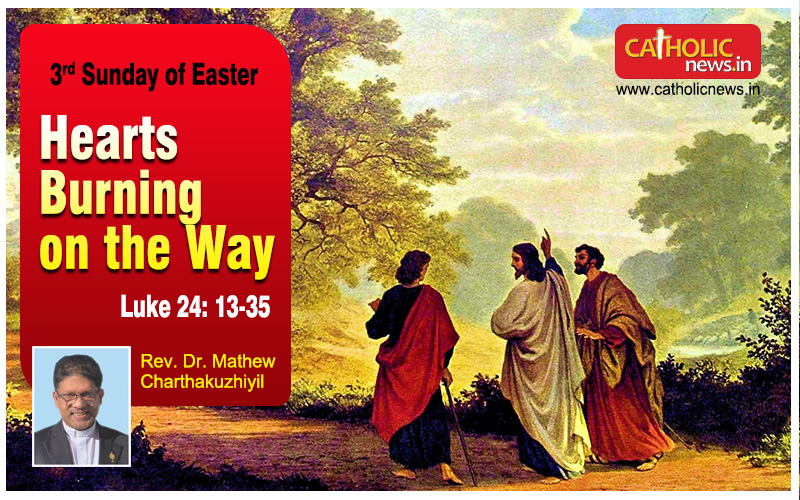
The Gospel of the disciples on the road to Emmaus is one of the most beautiful and profound accounts of the risen Lord’s encounter with his people. Two disciples walk away from Jerusalem, burdened by disappointment and confusion. Their hopes seem shattered. They had believed in Jesus, yet now they struggle to understand the meaning of his suffering and death. It is precisely in this moment of darkness that Jesus draws near to them, though they do not recognize him. This is often the way of God: he comes quietly and gently, walking beside us even when our eyes are unable to see.
The first movement of this encounter is the opening of the Scriptures. Jesus listens to them, allows them to express their sorrow, and then begins to interpret the Scriptures for them. He reveals that the path of the Messiah leads through suffering to glory. Here we learn that faith is not merely a feeling, but a light that comes from God’s word. As Saint Augustine beautifully says: “They saw him in the breaking of the bread, but they did not recognize him in the explanation of the Scriptures; yet without the Scriptures, they would not have recognized him in the breaking of the bread.” The word of God prepares the heart; it opens our eyes slowly to the presence of Christ.
The second movement is the breaking of the bread. At the table, their eyes are opened. They recognize him in the familiar gesture, the Eucharistic act. Then he vanishes from their sight, but not from their lives. What they had experienced remains within them as a burning fire. “Were not our hearts burning within us?” they say. This burning heart is the sign of a true encounter with Christ. It is not a passing emotion, but a deep inner certainty that God is near, that he speaks, and that he acts.
Dear brothers and sisters, this Gospel reveals to us the inner structure of every Eucharistic celebration. First, the Lord speaks to us in the Scriptures. Then, he gives himself to us in the breaking of the bread. Word and Sacrament belong together. Without the word, we do not understand the mystery; without the Eucharist, the word remains incomplete. In every Holy Mass, the road to Emmaus becomes present again. We come with our burdens and questions, and the Lord walks with us. He speaks to us, and he gives himself to us.
Very often, like the disciples, we fail to recognize him in the ordinary moments of life. Yet he is there-in the word we hear, in the Eucharist we receive, and even in the people we meet. Faith grows when we learn to see with the eyes of the heart. It grows when we remain open, patient, and attentive to his quiet presence.
Finally, the disciples do not remain where they are. They rise immediately and return to Jerusalem. Encounter with the risen Christ always leads to mission. Faith cannot be kept for oneself; it must be shared. The joy of recognizing the Lord becomes a message for others. So let us ask the Lord today to open our eyes, to make our hearts burn with his presence, and to send us forth as witnesses of his resurrection.
May our daily lives become like that road to Emmaus, where Christ walks with us, speaks to us, and reveals himself to us, until one day we recognize him fully in his eternal presence. In this hope, let us continue our journey with patience and trust, knowing that the Lord is always near, even when we do not see him, and that he gently leads us toward the fullness of life in him.
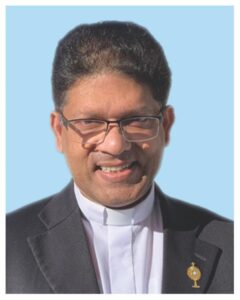
Fr. Mathew Charthakuzhiyil