



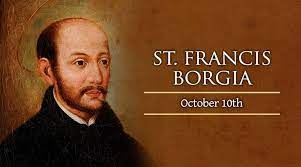
Francis Borgia was born in 1510 in Gandia, Valencia. His father was the Duke of Gandia. He grew up in Christianity from an early age. Francis was educated by a contemporary, and at the behest of Emperor Isabel, he married Leonor de Castro Mello. Their family life was quite happy.
In 1539, Emperor Isabel died. The task of bringing the body of the empress to the royal cemetery in Granada, accompanied by the army, was entrusted to Francis, Duke of Gandia and general of Catalonia. Francis was responsible for opening the coffin and examining the body before placing it on the grave. He opened the box for that. His heart was troubled by the change in the death of the beautiful Empress. Realizing the triviality of worldly beauties and luxuries, Francis wanted to start a new life. But he had to wait a long time for that.
After the death of his wife, at the age of 36, Francis gave up everything and entered the Jesuit Church. In 1551 Francis became a priest. He rode through the lands where he ruled as king and preached the crucified Messiah, to the poor peasants in torn clothes. He did not want any prestigious life. But then the saint was elected the universal head of the church. But as the status quo increased, the saint humbled himself more and more. He established thirty-one colleges in various countries. Evangelism intensified in Florida, Mexico, Crete, and Peru.
The saint had never done anything wrong in his life, but he always had in mind that he was the worst of them all. As the Turks prepared to invade Christian lands, Pope Pius V commissioned the saint to mobilize Christian kings against them. Exhausted by this endeavor, he died on October 10, 1522.
He was canonized on 20 June 1970 by Pope Clement X.