



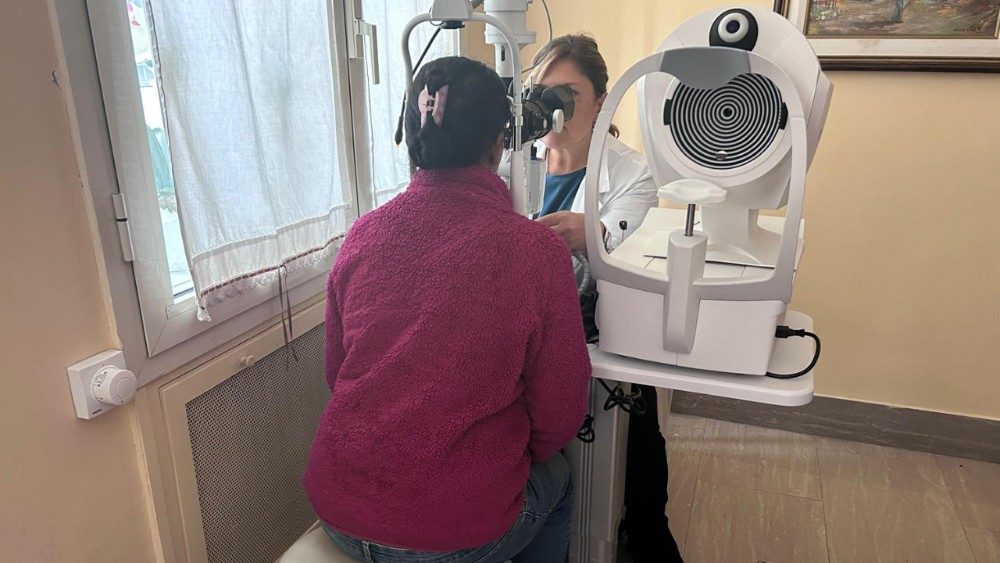
Marking World Sight Day, observed every second Thursday of October to raise awareness about preventable blindness and visual impairment, the Santa Marta Pediatric Dispensary in the Vatican offered free eye screenings and prescription glasses to around 50 children from poor families.This year’s theme, ‘Love Your Eyes’, is a reminder to put eye health at the forefront of personal and collective well-being.The Dispensary, which operates inside the Vatican near Casa Santa Marta, regularly assists hundreds of low-income local and international families. The eye-care initiative was made possible through a partnership with the OneSight EssilorLuxottica Foundation and the Dicastery for the Service of Charity.
Present at the dispensary on Thursday morning was the Prefect of the Dicastery, Archbishop Luis Marin de San Martin. He greeted the children queuing for their visit and described the initiative as a concrete testimony of the Church’s charitable action.”It is charity that adapts, with creativity, to changing needs,” he said, reiterating that “our doors are open to everyone because charity has no borders.”He said he was happy to have been appointed as the papal almoner, a role that has allowed him to come into contact with a wonderful reality that many are not aware of. The Pope’s charity, he added, reaches so many people thanks to “the saints next door,” the volunteers who give generously of their skills and time for the poor.”For me, these have been months of great personal, spiritual and pastoral enrichment,” the Archbishop concluded.
Among the volunteer doctors at the dispensary was ophthalmologist Dr Valeria Pendino of the Bietti Foundation. She said the foundation is very sensitive to the needs of disadvantaged families and that the collaboration came about through its work with socially oriented organisations.”I am happy that I found the time to be here today. For me, it has been a very powerful experience because in our field, prevention is essential,” she said.She noted that she had examined older children and young adults who would have had a different course if they had been diagnosed and treated during childhood. Some of the children examined had never undergone scheduled eye checks and had visual impairments that hindered the development of one or both eyes. Now, she said, a course of treatment and follow-up lies ahead.