



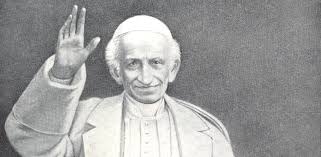
Pope Leo XIII was the head of the Catholic Church from 20 February 1878 to his death in 1903. Living until the age of 93, he was the second-oldest-serving Pope, before Pope Agatho and the third-longest-lived pope in history, before Pope Benedict XVI as Pope emeritus, and had the fourth-longest reign of any, behind those of St. Peter, Pius IX (his immediate predecessor) and John Paul II.
Pope Leo XIII issued a record of eleven papal encyclicals on the rosary, earning him the title of the “Rosary Pope”. In addition, he approved two new Marian scapulars and was the first pope to fully embrace the concept of Mary as Mediatrix. Here we share the quotes of Pope Leo XIII on Rosary.
1. Thanks to this new method of prayer—when adopted and properly carried out as instituted by the Holy Father St. Dominic—piety, faith and union began to return, and the projects and devices of the heretics to fall to pieces. – Supremi Apostolatus Officio, 3.
2. May our Heavenly Patroness, invoked by us through the Rosary, graciously be with us and obtain that, all disagreements of opinion being removed and Christianity restored throughout the world, we may obtain from God the wished-for peace in the Church. – Superiore Anno, 6.
3. In every great crisis of Christendom, and every time the Church was afflicted by evils within or dangers without, our forefathers, with their eyes lifted to Heaven in supplication, taught us how and when we should seek for the light of our souls, for the strength of virtue, and for help suited to the need. For deeply engraved upon men’s minds were these precepts of Jesus Christ: “Ask and it shall be given you;” “We ought always to pray and not to faint.” . . . From all this, Venerable Brethren, each one of you may gather how agreeable to us and how commendable is the zeal with which at our suggestion you have spread the devotion to the Most Holy Rosary. – Quod Auctoritate, 5-6.
4. Mindful that in moments of great trial, pastors and people have ever had recourse with entire confidence to the august Mother of God, in whose hands are all graces, certain too, that devotion to Our Lady of the Rosary is most opportune for the needs of these times, we have desired to revive everywhere this devotion, and to spread it far and wide among the faithful of the world. – Vi e Ben Noto, 1.
5. We prescribe that during the whole month of October, at the recitation of the Rosary, for which We have already legislated, a prayer to St. Joseph be added. – Quamquam Pluries, 6
6. After slamming the door on secret societies that conspire against the Catholic Church, to include Freemasons: “Let us take as our mediatrix with God the most glorious Virgin Mary, the invincible Queen of the Rosary, Who has such great power over the forces of hell, and has so many times made [us] feel the effects of Her maternal love. – Dall’Alto Dell’Apostolico Seggio, 19.
7. The contemplation of these august mysteries, contemplated in their order, affords to faithful souls a wonderful confirmation of faith, protection against the disease of error, and increase of the strength of the soul. The soul and memory of him who thus prays, enlightened by faith, are drawn towards these mysteries by the sweetest devotion, are absorbed therein and are surprised before the work of the Redemption of mankind, achieved at such a price and by events so great. – Octobri Mense, 7.
8. The prayer is composed of words proceeding from God Himself, from the Archangel Gabriel, and from the Church; full of praise and of high desires; and it is renewed and continued in an order at once fixed and various; its fruits are ever new and sweet. – Octobri Mense, 7.
9. By [praying the Holy Rosary] the Church triumphed magnificently over every obstacle and provided for the salvation of her children not only in that trial but in others like it afterward, always with the same glorious success. – Magnae Dei Matris, 8.
10. For we are convinced that the Rosary, if devoutly used, is bound to benefit not only the individual but society at large. – Laetitiae Sanctae, 3.
11. The recourse we have to Mary in prayer follows upon the office she continuously fills by the side of the throne of God as Mediatrix of Divine grace; being by worthiness and by merit most acceptable to Him, and, therefore, surpassing in power all the angels and saints in Heaven. Now, this merciful office of hers, perhaps, appears in no other form of prayer so manifestly as it does in the Rosary. – Lucunda Sember Expectatione, 2.
12. The very origin of the Rosary makes that plain. When such faith is exercised by vocally repeating the Our Father and Hail Mary of the Rosary prayers, or better still in the contemplation of the mysteries, it is evident how close we are brought to Mary. For every time we devoutly say the Rosary in supplication before her, we are once more brought face to face with the marvel of our salvation; we watch the mysteries of our Redemption as though they were unfolding before our eyes; and as one follows another, Mary stands revealed at once as God’s Mother and our Mother. – Adiutricem, 25.
13. The form of prayer we refer to has obtained the special name of “Rosary,” as though it represented by its arrangement the sweetness of roses and the charm of a garland. This is most fitting for a method of venerating the Virgin, who is rightly styled the Mystical Rose of Paradise, and who, as Queen of the universe, shines therein with a crown of stars. – Fidentem Piumque Animum, 2.
14. So far from this derogating in any way from the honor due to God, as though it indicated that we placed greater confidence in Mary’s patronage than in God’s power, it is rather this which especially moves God, and wins His mercy for us. We are taught by the Catholic faith that we may pray not only to God himself, but also to the Blessed in heaven, though in different manner; because we ask from God as from the Source of all good, but from the Saints as from intercessors. – Augustissimae Virginis Mariae, 9.
15. [We popes] have ever repeatedly encouraged the recitation of the Holy Rosary, and have endeavoured to increase its dignity by a more solemn cult, following in this the footsteps of our predecessors. Pope Sixtus V, of happy memory, approved the ancient custom of reciting the Rosary; Gregory XIII dedicated a day under this title, which Clement VIII afterwards inscribed in the martyrology, and Clement XI extended to the Universal Church. Benedict XIII inserted the feast in the Roman Breviary, and [we popes], ourselves, in perpetual testimony of Our affection for this devotion commanded that the solemnity with its office should be celebrated in the Universal Church as a double of the second class, consecrating to this devotion the entire month of October. Finally we ordered the addition to the Litany of Loreto of the invocation “Queen of the most Holy Rosary,” as an augury of victory in our present warfare. – Diuturni Temporis, 4