



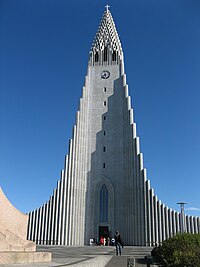
Hallgrímskirkja is a Lutheran (Church of Iceland) parish church in Reykjavík, Iceland. This is the largest church in Iceland with 74.5 meters (244 ft) tall. The Church is known for its distinctively curved spire and side wings. This church has been an important symbol of Iceland’s national identity since its completion in 1986. The church is named after the Icelandic poet and cleric Hallgrímur Pétursson (1614–1674), author of the Passion Hymns.
The Church is situated on the hilltop Skólavörðuholt [ˈskouːlaˌvœrðʏˌhɔl̥t] near the centre of Reykjavík. Architecturally, Hallgrímskirkja consists of three parts: The tower with the distinctly curved side wings that house service facilities, a nave in more traditional architecture, and a sanctuary at the other end of the nave, whose cylindrical shape has been described as evoking Viking war helmets. Hallgrímskirkja also has a 244 ft (74.37 meters) dome.
Hallgrímskirkja is best described as a piece of Expressionist architecture because of its tower-like exterior, its rejection of traditional styles and its dynamic design. It was heavily influenced by another building, Grundtvigskirken. Like Hallgrímskirkja, Grundtvigskirken has an organ-like appearance. The interior is 1,676 square metres (18,040 sq ft).
The church has a carillon of bells at the top, that ring each hour.
Einar Jónsson donated the statue of Jesus to the church in 1948, which stands right next to the entrance to the nave. Jesus receives the Holy Spirit after being baptized in the Jordan.
The church is also used as an observation tower. An observer can take a lift up to the viewing deck and view Reykjavík and the surrounding mountains.