


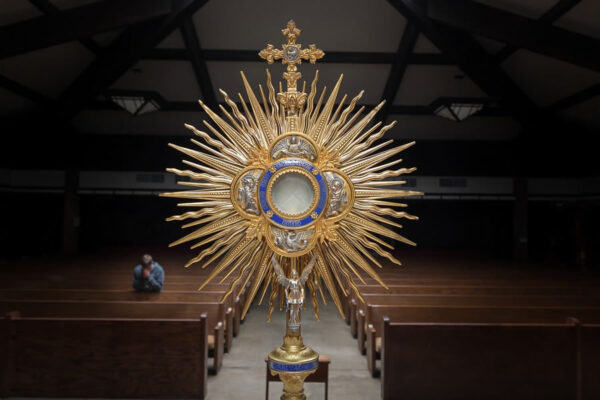
The feast of ‘Corpus Christi’ also known as the Solemnity of the Most Holy Body and Blood of Christ, in the Holy Catholic Church has a long history. The Eucharistic miracle that took place in Italy is what led to the establishment of this feast by Pope Urban IV in the thirteenth century.
In the middle of the thirteenth century, a priest from Prague, Fr. Peter doubted the presence of Christ in the Holy Eucharist. He made a pilgrimage to Rome to seek the grace to restore his faith. The goal was to pray at Saint Peter’s grave. He returned after the pilgrimage and went to Bolsena to offer Holy Mass at Christina’s grave. During the Holy Mass, the bread and wine become the body and blood of Christ at the moment of consecration. Pope Urban IV, was the then Pope of Orvieto, near Bolsena. Upon hearing the news of the miracle, the Pope immediately asked the priest to bring it to him. The pope, who witnessed the miracle of Divine Mercy, knelt before the Blood and Body of Christ and worshiped. The relics placed in the cathedral. The linen corporal bearing the spots of blood is still reverently enshrined and exhibited in the Cathedral of Orvieto. It is said that Pope Urban IV was prompted by this miracle to commission St. Thomas Aquinas to compose the Proper for a Mass and an Office honoring the Holy Eucharist as the Body of Christ. One year after the miracle, in August of 1264, Pope Urban IV introduced the saint’s composition, and by means of a papal bull instituted the feast of Corpus Christi.