



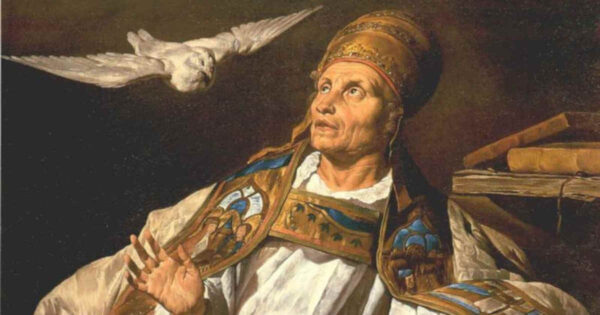
St. Gregory the Great, a central figure of the medieval western Church and one of the most admired Popes in history.
He was born near the middle of the sixth century into a noble Roman family. Gregory received a classical education in liberal arts and the law. As his family is devout, he also had a strong religious formation. His mother was very keen to take her son to the world of faith. She is also a saint whose name is Silvia. By around age 30, Gregory had
advanced to high political office in Rome, during what was nevertheless a period of marked decline for the city.
Sometime after becoming the prefect of the former imperial capital, Gregory chose to leave the civil administration to become a monk during the rise of the Benedictine order. In reality, however, the new monk’s great career in public life was yet to come.
After three years of strict monastic life, he was called by the Pope to assign the office of a deacon in Rome. From Rome, he was shifted to Constantinople. It was to seek aid from the emperor for Rome’s civic troubles and to aid in resolving the Eastern church’s theological controversies. He returned to Rome in 586, after six years of service as the Papal representative to the eastern Church and empire.
He was appointed the Bishop in Rome later. Despite this initial reluctance, however, Pope Gregory began working tirelessly to reform and solidify the Roman liturgy, the disciplines of the Church, the military and economic security of Rome, and the Church’s spreading influence in western Europe.
Pope Gregory saw himself as the “servant of the servants of God.” He was the first of the Bishops of Rome to popularize the now-traditional Papal title, which referred to Christ’s command that those in the highest position of leadership should be “the last of all and the servant of all.”
Even as he undertook to consolidate Papal power and shore up the crumbling Roman west, St. Gregory the Great maintained a humble sense of his mission as a servant and pastor of souls, from the time of his election until his death in 604.