



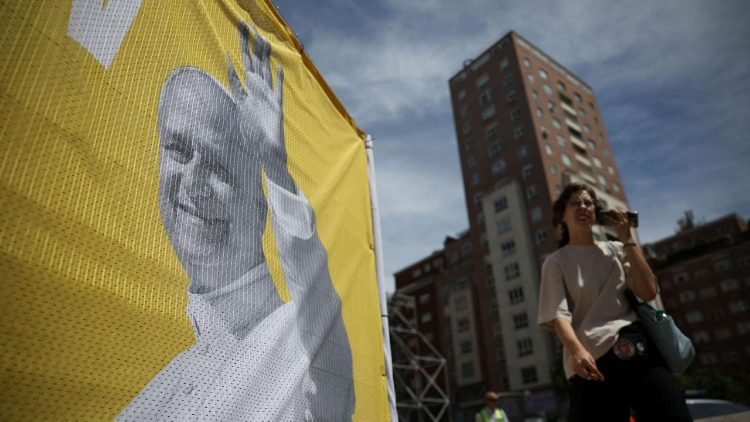
The Director of the Holy See Press Office, Matteo Bruni, outlined Pope Leo XIV’s fourth international Apostolic Journey to Spain, scheduled for June 6–12, with stops in Madrid, Barcelona, and the Canary Islands. The trip will cover about 2,500 kilometers and is expected to draw around half a million faithful.
Bruni described Spain as “a land of ancient Christian tradition” that served as “a laboratory of dialogue between different worlds in the heart of the Middle Ages.” He cited the School of Salamanca, where scholastic theology and international law met in the sixteenth century, and recalled saints such as St. John of the Cross and St. Teresa of Ávila, whose thought “resonates prophetically with the challenges of our own time.”In Spain, the Pope will meet Church and public institution representatives, as well as young people, families, and figures from sport, culture, and entertainment. Some will take part in public events.
Dialogue between Church, politics, and culture as tools for overcoming polarization, along with reflection on technological and human progress in light of the encyclical Magnifica Humanitas, will be central themes of the Pope’s 23 speeches, greetings, and homilies. Peace will also be a major focus “in an age marked by wars.” Closely linked is disarmament, “at a time when the use of weapons is increasingly being justified,” Bruni noted.“In this sense,” he added, “one may also reflect on the role of the Church in Spain, and more broadly in Europe, in light of its history—all of its history—as a precious treasure in moments of greatness as well as in times of crisis.”
The visit is intended as encouragement for a Church that “still has much to say on many levels, in Spain and in Europe, where it can fully contribute as a constructive participant in public debate,” Bruni said. He also referenced “the defense of life”—every life, especially the most vulnerable.
Migration will come into sharp focus during the Pope’s visit to the ports of the Canary Islands, an area that has seen many human and family tragedies along the Atlantic migration route. There, the Pope will hear migrants’ stories and witness welcome efforts in “a land of missionary saints who departed from here to bring the Gospel to the world.”A particularly significant moment will follow the Pope’s first address to institutions, civil society, and the diplomatic corps, when he visits the social project “Cedia 24 Horas” in Madrid’s Lucero district, a center for vulnerable people and the homeless. Cardinal José Cobo Cano, Archbishop of Madrid, observed that the Pope will “enter the country through the world of vulnerability and human peripheries.” Encountering Spain’s faith and culture
Stops in Madrid and Barcelona will include the Basilica of Sagrada Família, during the centenary year of Antoni Gaudí’s death, commemorated on June 10.
Pope Leo will inaugurate the Tower of Jesus Christ—the crowning feature of Gaudí’s work—with a blessing followed by a light and fireworks display. Bruni said the Pope “is addressing a people living in a highly secularized society, yet one in which Christian roots remain deeply embedded in cultural references and beyond.” The journey is “an encounter with the faith of a people” still attached to popular religious traditions like processions. The Pope will take part in the Corpus Christi procession on Sunday, June 7. It is “a faith that does not remain confined within church walls but walks through the streets,” Bruni said, borrowing Pope Francis’s phrase: not “a museum faith” but “a faith that bears fruit for the future.” Young people from Spain and beyond will be another focus. The Pope intends to offer “a message rich in substance, capable of imagining the future together with them, and of inspiring the Church, in an age of strong men, to raise up holy men and women.”
The itinerary includes the Royal Palace and Congress of Deputies, Madrid’s Movistar Arena and Santiago Bernabéu Stadium, the Abbey of Montserrat, and the port of Arguineguín in Gran Canaria. The port has long been known as the “pier of shame” because of overcrowded and precarious conditions faced by thousands of migrants, mainly from West Africa. Traveling with the Pope will be Cardinal Ángel Fernández Artime, Pro-Prefect of the Dicastery for Institutes of Consecrated Life and Societies of Apostolic Life; Archbishop Filippo Iannone, Prefect of the Dicastery for Bishops; and Archbishop Luis Marín de San Martín, the Papal Almoner. All the Pope’s speeches will be in Spanish, except for one address in French at the Las Raíces reception center, which hosts migrants from French-speaking African countries. Bruni said the Pope may also speak a few words in Catalan.
On the topic of abuse, Bruni explained that the Church in Spain has been involved in prevention and reparative justice initiatives, including a protocol agreed upon last March by the Bishops’ Conference, the Conference of Religious, the Spanish Ombudsman’s Office, and the Ministry of the Presidency. At present, no private meeting between the Pope and abuse victims is scheduled.