



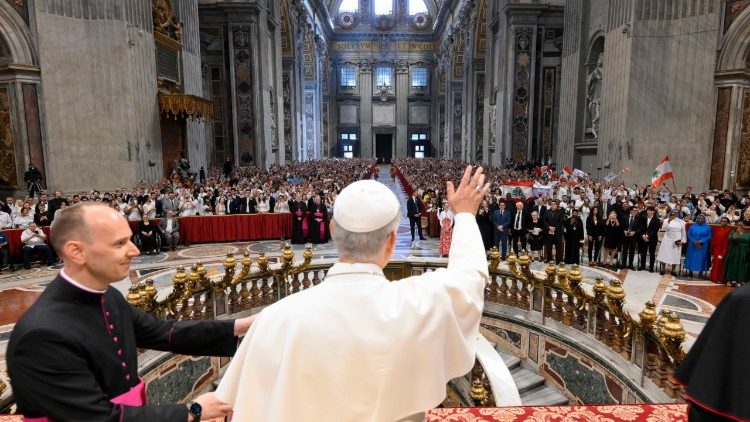
During his Wednesday General Audience, Pope Leo XIV reflected on the role of sacred music in the Catholic liturgy, emphasizing that its primary purposes are to glorify God and lead the faithful toward holiness. Continuing his series of catecheses on Sacrosanctum Concilium—the Second Vatican Council’s Constitution on the Sacred Liturgy—the Pope focused on its sixth chapter, echoing the document’s assertion that the Church’s musical tradition is a “treasure of inestimable value” that acts as an integral component of liturgical action rather than a passive backdrop.
The Pontiff highlighted that liturgical music serves as a profound expression of prayer and a driver of ecclesial communion. Quoting St. Augustine’s phrase “Cantare amantis est” (“singing belongs to those who love”), Pope Leo explained how music engages the affective dimension of faith, opening hearts to divine grace. Furthermore, he noted that unified singing creates a “symphony of voices” that bridges individual differences, serving as a visible manifestation of the Church’s communal nature.
Addressing the requirements for sacred compositions, Pope Leo stressed that liturgical music must remain noble, simple, and accessible enough for the entire assembly to participate. He called for compositions that draw inspiration directly from Sacred Scripture, liturgical texts, and the Church’s spiritual tradition, warning against relying on fleeting fashions or individual composer preferences. While affirming the supreme place of Gregorian chant and encouraging local cultural traditions through inculturation, he echoed Pope St. John Paul II’s call to safeguard the liturgy from poor style or uninspired texts.
In closing, Pope Leo urged Catholic seminaries, religious houses, and schools to prioritize proper liturgical and musical formation for musicians and clergy alike. Citing St. Ignatius of Antioch, he invited all believers to form a unified choir—attuning their hearts to God so that their shared praise and good works may reflect their bond as members of Christ.