



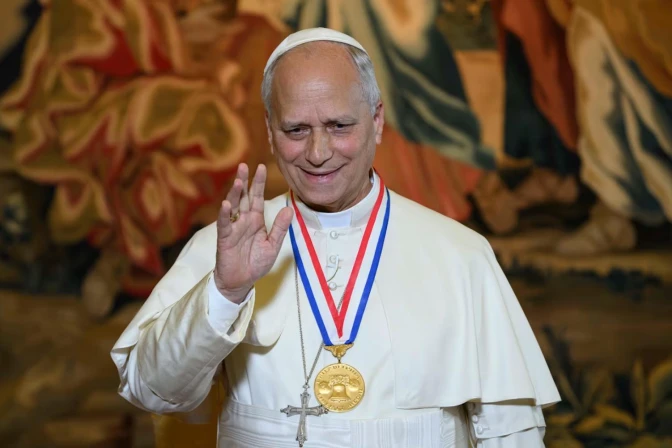
Pope Leo XIV said he was “honored” to accept the 2026 Presidential Medal of Freedom from the National Constitution Center (NCC), in a message broadcast live during the ceremony held in Philadelphia on July 3.“I am honored to accept the Medal of Freedom from the National Constitution Center in this year that marks the 250th anniversary of the founding of the United States of America with the signing of the Declaration of Independence on July 4, 1776,” the Holy Father stated.Born in Chicago, Pope Leo earned his bachelor’s degree from Villanova University, located in the suburbs of Philadelphia. The NCC personally presented the award to the Pope at the Vatican on April 30, prior to the ceremony.In his message, the Pope thanked those gathered in Philadelphia for the occasion.
The NCC building is located across the street from the Liberty Bell and Independence Hall, where the nation’s Founding Fathers drafted and approved the Declaration of Independence, the Constitution, and the Bill of Rights.“As a son of this great nation, founded by brave men and women who dreamed of freedom and a better life for themselves and their children, I join you in asking for God’s blessing on the future of the United States, that the high ideals enshrined at the beginning of the Declaration of Independence may continue to guide the nation’s flourishing in unity, justice, and peace,” Pope Leo said.
“From our youth, most of us have admired the eloquence of those words, with their resounding appeal to natural law and to the God of that nature as the basis for their assertion that all men and women are created equal and endowed by their Creator with certain unalienable rights, among them the right to life, liberty and the pursuit of happiness,” he noted.The Pope said that, although the text uses “the language of the Enlightenment,” the statement “is ultimately based on an understanding of the human person inspired by the great biblical vision of man and woman created in the divine image.”“It is precisely there that we discover the foundation of human dignity; a dignity that precedes the establishment of any State and whose protection constitutes precisely its purpose,” he said.
He added that respecting the right to life “in all forms and conditions” is directly related to the vitality of the nation. Society must cultivate a reverence for life that “moves people’s hearts and inspires laws that recognize and safeguard this gift from the moment of conception until natural death.”The right to freedom, the Pope affirmed, goes deeper than simply doing what one wants. It is “founded on the capacity of the human person to know the truth and to adhere to what is good, even at a great cost, a sacrifice well known to many who have worked to forge this country,” he said.“The desire for truth and freedom, as well as the very pursuit of happiness, continues to inspire people of all generations to ask fundamental questions about the meaning of life, our ultimate purpose, and ultimately, about God; and it is up to magnanimous hearts to strive to answer these questions with sincerity,” Pope Leo said.
The Holy Father called religious freedom — “the power to be free from fear and coercion, as enshrined in the First Amendment of the United States Constitution” — necessary to answer those questions.“I hope this tradition will continue to bear fruit in a public debate marked by moderation, respect for the opinions of others, and a constant effort to find common ground to promote the cause of peace and reconciliation, both within and outside the country,” he added.The Pope said he prays that the 250th anniversary of the United States “will be an occasion to solemnly renew the commitment to these ideals that have made the United States a country that values peace and prosperity, a country characterized by generosity and nobility of heart.”Archbishop Pérez and Governor Shapiro participate in the ceremony.