



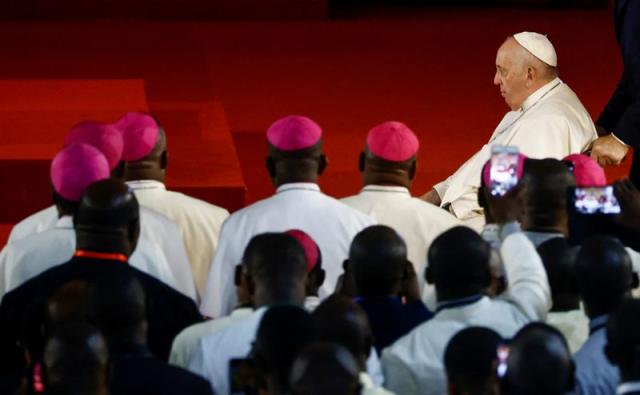
On the fourth day of his apostolic visit to the Democratic Republic of the Congo, Pope Francis held a meeting with the bishops today, on 3 February at the headquarters of the National Episcopal Conference of the Congo (CENCO).
Below is the full text of Pope Francis’ words:
Dear brother bishops, good morning!
I am pleased to meet you and I thank you from the bottom of my heart for the warm welcome. Thanks to Msgr. Utembi Tapa for the greeting he addressed to me and for having given them a voice with his words: I thank you for how you courageously announce the comfort of the Lord, walking in the midst of the people, sharing their hardships and his hopes of him .
It has been beautiful for me to spend these days in your land, which with its great jungle represents the “green heart” of Africa, a lung for the entire world. The importance of this ecological heritage reminds us that we are called to preserve the beauty of creation and defend it from the wounds caused by rapacious selfishness. But this immense green expanse that is your jungle is also an image that speaks to our Christian life. As Church we need to breathe the pure air of the Gospel, expel the polluted air of worldliness and guard the young heart of faith. This is how I imagine the African Church and this is how I see this Congolese Church, a young, dynamic, joyful Church, animated by missionary yearning, by the proclamation that God loves us and that Jesus is Lord.Your Church is present in the concrete history of this people, deeply rooted in reality, protagonist of charity; a community capable of attracting and infecting with its enthusiasm and, therefore, like your jungles, with a lot of “oxygen”. Thank you for being a lung that gives breath to the Universal Church!
It’s sad to start a paragraph with the word “unfortunately”, but I have to.
Unfortunately, I am well aware that the Christian community on this earth also has a different physiognomy. Indeed, your young, luminous and beautiful face is furrowed by pain and fatigue, marked at times by fear and discouragement. It is the face of a Church that suffers for her people, it is a heart in which the life of the people beats intensely with its joys and tribulations. It is a Church that is a visible sign of Christ who, even today, is rejected, condemned and despised in so many crucified people in the world, and cries our own tears. It is a Church that, like Jesus, also wants to dry the tears of the people, committing to assume the material and spiritual wounds of the people, and pouring on them the living and healing water from the side of Christ.
With you, brothers, I see Jesus suffering in the history of this crucified and oppressed person, devastated by unforgiving violence, marked by innocent pain, and forced to live with the murky waters of corruption and injustice that contaminate humanity. society; and that he suffers poverty in so many of his children from him. But at the same time, I see a people who have not lost hope, who enthusiastically embrace the faith and look to their Pastors, who know how to return to the Lord and trust in his hands, because the peace they long for, suffocated by exploitation, by group egoism, due to the poison of conflicts and manipulated truths, can finally arrive as a gift from on high.
It is worth asking, how to exercise the ministry in this situation. Thinking of you, shepherds of the holy People of God, the story of Jeremiah came to mind, a prophet called to live his mission from him at a dramatic moment in the history of Israel, in the midst of injustice, abominations and suffering. He spent his life announcing that God never abandons his people and carries out peace projects even in situations that seem lost and irrecoverable. But in this consoling proclamation of faith, Jeremiah lived first of all in his person, he was the first to experience the closeness of God. Only then could he bring to others a courageous prophecy of hope. Your episcopal ministry also lives between these two dimensions, of which I would like to speak to you: the closeness of God and prophecy for the people.
First of all, I would like to invite you to allow yourself to be embraced and comforted by the closeness of God. The first word that the Lord addresses to Jeremiah is this: “Before I formed you in the womb, I knew you” (Jer 1,5). It is a declaration of love that God carves in the heart of each one of us, that no one can erase and that, in the midst of life’s storms, is a source of comfort. For us, who have received the call to be shepherds of the People of God, it is important to be grounded in this closeness to the Lord, “structure ourselves in prayer”, spending hours before Him. entrusted and only thus will we truly become shepherds, since we, without Him, can do nothing (cf. Jn 15,5). We would be entrepreneurs and businessmen. We would be teachers in quotes, but we would not be behind the vocation of the Lord. Without Him we can do nothing. That it is not going to happen that we believe ourselves to be self-sufficient, much less that the possibility of climbing social positions and exercising power is seen in the episcopate. That ugly spirit of racing! And, above all, the spirit of worldliness does not enter, which makes us interpret the ministry according to criteria of personal benefit, which makes us cold and distanced from the administration of what has been entrusted to us, which leads us to use the role before than to serve others, and no longer take care of that indispensable relationship, that of humble and daily prayer. Let us not forget that worldliness is the worst thing that can happen to the Church, the worst. I always had the end of Cardinal de Lubac on the Church. The last three or four pages say like this: Spiritual worldliness is the worst thing that can happen. Worse still than the time of worldly popes and concubines. It is worse. Worldliness is at hand. Let’s stay tuned.
Dear brother bishops, let us take care of our closeness to the Lord in order to be his credible witnesses and spokesmen for his love before the people. He wants to anoint him through us with the oil of consolation and hope. You are the voice with which God wants to say to the Congolese: “You are a people consecrated to the Lord, your God” (Dt 7,6). The proclamation of the Gospel, the animation of pastoral life and the guidance of the people cannot be resolved with principles distant from the reality of daily life but must touch the wounds and communicate divine closeness, so that people discover their dignity as Children of God and learn to walk with your head held high, without bowing your head in the face of humiliation and oppression. Through you, these people have the grace to feel words addressed to them similar to those that the Lord said to Jeremiah: “You are a blessed people, before forming you I had already thought about you, known you, loved you.” If we cultivate closeness to God, we feel impelled toward the people and we will always feel compassion for those entrusted to us. That attitude of compassion is not a feeling. It is a “suffer with”. Encouraged and strengthened by the Lord, we become, in turn, instruments of consolation and reconciliation for others, to heal the wounds of those who suffer, mitigate the pain of those who cry, and lift up the poor, free people of so many forms of slavery and oppression. So that closeness to God gives prophets for the people,
To get into this second point, the prophecy to the people, let’s look again at Jeremiah’s experience. After having received the loving and consoling Word of God, he is called to be a “prophet to the nations” (Jr 1,5), sent to bring light into the darkness, to bear witness in a context of violence and corruption. And Jeremiah, who devours the Word of the Lord, since it is for him joy and gladness of the heart (cf. Jr 15,16), confesses that this same Word sows in him a restlessness that is impossible to suppress and leads him to meet others to May they be embraced by the presence of God. And he says like this: “But there was in my heart – he writes – like a burning fire, shut up in my bones: I tried to contain it, but could not” (Jer 20,9).We cannot retain only for ourselves the Word of God, we cannot contain its strength; it is a fire, a fire that burns our apathy and ignites in us the desire to illuminate those who are in the dark. The Word of God is a fire that burns inside and pushes us out. This is our episcopal identity: lit by the fire of the Word of God, going out toward the People of God, with apostolic zeal.
But—we could ask ourselves—what does this prophetic proclamation of the Word consist of? To the prophet Jeremiah the Lord says: «I put my words in your mouth. I establish you on this day over nations and over kingdoms, to uproot and tear down, to lose and demolish, to build and plant” (Jer 1,9-10). They are strong verbs: first uproot and tear down, to then be able to build and plant. It is about collaborating in favor of a new history that God wants to build in a world of perversion and injustice. So you too are called to continue raising your prophetic voice, so that consciences feel challenged and each one can be the protagonist and responsible for a different future. Therefore, it is necessary to uproot the poisonous plants of hatedness and selfishness, rancor and violence; tear down the altars dedicated to money and corruption; build a coexistence founded on justice, truth and peace; and finally, planting seeds of renewal, so that the Congo of tomorrow will truly be the one that the Lord dreams of, a blessed and happy land, no longer mistreated, oppressed or bloodied.
But let’s be careful because this is not a political action. Christian prophecy is embodied in many political and social actions, but the task of bishops and pastors in general is not this. It is rather that of the announcement of the Word to awaken consciences, to denounce evil, to encourage those who are dejected and without hope. “Comfort my people.” That motto that returns and returns is an invitation from the Lord: Comfort the people. Comfort, comfort my people. It is an announcement made not only with words, but with closeness and witness: closeness, above all, with priests (priests are the first neighbor of a Bishop: closeness to priests), listening to pastoral agents, support for the synodal spirit to work together.And testimony, because pastors, first and foremost, must be credible, and in particular when cultivating communion, in the moral life and in the administration of goods. In this sense, it is essential to know how to build harmony, without getting on pedestals, without harshness, but rather setting a good example with mutual support and forgiveness, working together as models of fraternity, peace and evangelical simplicity. May it never happen that, while the people suffer from hunger, it is said of you: “they do not care and one goes to his field, another to his business” (cf. Mt 22,5). No, please, let’s leave business out of the Lord’s vineyard. A pastor can’t be a businessman, he can’t.Let us be pastors and servants of the people of God, not administrators of things, not businessmen. Shepherds! It is essential to know how to build harmony, without getting on pedestals, without harshness, but by setting a good example with mutual support and forgiveness, working together, as models of fraternity, peace and evangelical simplicity. May it never happen that, while the people suffer from hunger, it is said of you: “they do not care and one goes to his field, another to his business” (cf. Mt 22,5). No, please, let’s leave business out of the Lord’s vineyard. A pastor can’t be a businessman, he can’t. Let us be pastors and servants of the people of God, not administrators of things, not businessmen. Shepherds!It is essential to know how to build harmony, without getting on pedestals, without harshness, but by setting a good example with mutual support and forgiveness, working together, as models of fraternity, peace and evangelical simplicity. May it never happen that, while the people suffer from hunger, it is said of you: “they do not care and one goes to his field, another to his business” (cf. Mt 22,5). No, please, let’s leave business out of the Lord’s vineyard. A pastor can’t be a businessman, he can’t. Let us be pastors and servants of the people of God, not administrators of things, not businessmen. Shepherds! Let it be said of you: “they do not care and one goes to his field, another to his business” (cf. Mt 22,5).No, please, let’s leave business out of the Lord’s vineyard. A pastor can’t be a businessman, he can’t. Let us be pastors and servants of the people of God, not administrators of things, not businessmen. Shepherds! Let it be said of you: “they do not care and one goes to his field, another to his business” (cf. Mt 22,5). No, please, let’s leave business out of the Lord’s vineyard. A pastor can’t be a businessman, he can’t. Let us be pastors and servants of the people of God, not administrators of things, not businessmen. Shepherds!
The administration of the bishop should be that of the pastor. In front of the flock, behind and in the middle. Ahead to point the way. In between to feel the smell. And behind to help those who go slower. And, what’s more, to leave the herd a bit just so they can see where they find the pasture. The pastor must find himself between these three situations.
Dear brother bishops, I have shared with you what I felt in my heart, that is, to cultivate closeness with the Lord in order to be prophetic signs of his compassion for the people. I beg you not to neglect dialogue with God and do not let the fire of prophecy go out because of calculations or ambiguities with power, nor because of a quiet life or routine. Before the people who suffer and in the face of injustice, the Gospel asks us to raise our voices. When, according to God, we raise our voices, we take risks. Raising his voice from him was made by your brother, the servant of God Mons. Christophe Munzihirwa, courageous pastor and prophetic voice, who protected his people from him by offering his life from him.The day before he died he sent a message to everyone, saying: “In these days, what else can we do? Let us remain firm in the faith. Let us trust that God will not abandon us and that from somewhere a small glimmer of hope will emerge for us. God will not abandon us if we commit to respecting the lives of our neighbors, regardless of the ethnic group to which they belong. The day after he was murdered-he was murdered-in a city square, but his seed from him, planted in this land, along with many others, will bear fruit. It is good to remember, with gratitude, the great pastors who marked the history of your country and of your Church; who evangelized them and preceded them in the faith.Brothers, they are your roots, which strengthen you in the evangelical ardor. I am also thinking of the good that meeting Cardinal Laurent Monsengwo Pasinya has done for me. God will not abandon us if we commit to respecting the lives of our neighbors, regardless of the ethnic group to which they belong. The day after he was murdered-he was assassinated-in a city square, but his seed from him, planted in this land, along with many others, will bear fruit. It is good to remember, with gratitude, the great pastors who marked the history of your country and of your Church; who evangelized them and preceded them in the faith. Brothers, they are your roots, which strengthen you in the evangelical ardor.I am also thinking of the good that meeting Cardinal Laurent Monsengwo Pasinya has done for me. God will not abandon us if we commit to respecting the lives of our neighbors, regardless of the ethnic group to which they belong. The day after he was murdered-he was assassinated-in a city square, but his seed from him, planted in this land, along with many others, will bear fruit. It is good to remember, with gratitude, the great pastors who marked the history of your country and of your Church; who evangelized them and preceded them in the faith. Brothers, they are your roots, which strengthen you in the evangelical ardor. I am also thinking of the good that meeting Cardinal Laurent Monsengwo Pasinya has done for me.to the great pastors who marked the history of your country and of your Church; who evangelized them and preceded them in the faith. Brothers, they are your roots, which strengthen you in the evangelical ardor. I am also thinking of the good that meeting Cardinal Laurent Monsengwo Pasinya has done for me. to the great pastors who marked the history of your country and of your Church; who evangelized them and preceded them in the faith. Brothers, they are your roots, which strengthen you in the evangelical ardor. I am also thinking of the good that meeting Cardinal Laurent Monsengwo Pasinya has done for me.
Dear brothers, do not be afraid to be prophets of hope for the people, harmonious voices of the Lord’s consolation, joyful witnesses and announcers of the Gospel, apostles of justice, Samaritans of solidarity; witnesses of mercy and reconciliation in the midst of the violence unleashed not only by the exploitation of resources and by ethnic and tribal conflicts, but also and above all, by the dark force of the evil one, enemy of God and man. But never be discouraged, the Crucified has risen – the Crucified has risen! fertile seed of peace. I want to thank you, brothers, for your service, your pastoral zeal and your testimony.
Coming to the end of this trip, I would like to express my gratitude to all of you and to all who have prepared it. They had the patience to wait a year. They are very good. Thank you very much for this. They had to work twice as hard, because the visit was canceled the first time, but I know that they are merciful to the Pope. Really, thank you. Next June they will celebrate the National Eucharistic Congress in Lubumbashi. Jesus is truly present and active in the Eucharist; there he gives peace and restores, consoles and unites, illuminates and transforms; there he inspires, sustains and makes effective his ministry from him.May the presence of Jesus, meek and humble-hearted shepherd, victor over evil and death, transform this great country and always be your joy and your hope.
And I would like to add just one thing. He said, “Be merciful.” Mercy. Forgive, always. When a faithful person comes to confess, he comes to ask the father for a care and not an accusing finger. “And how many times?” “And how did you do it?” No, not that. Forgive. “But I don’t know, because the Code tells me…” well, we must see the Code because it is serious. But the pastor’s heart goes further. Take risks, for forgiveness, take risks. Forgive always in the Sacrament of Reconciliation and thus you will sow forgiveness for the whole of society.
I bless you from the heart. And please keep praying for me. Thanks.