



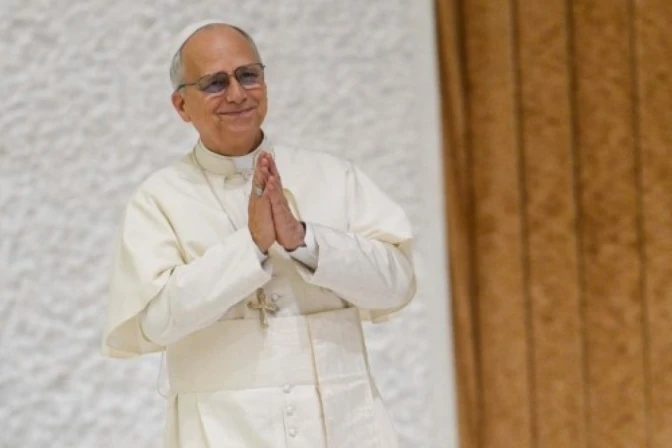
The following is the message of Pope Leo XIV for the World Day of Grandparents and Older Persons, which this year will be celebrated on July 26, with the title “But I will never forget you” (Is 49:15):
Dear brothers and sisters:
Through the prophet Isaiah, the Lord promises that he will never forget any of us. He assures us that he has engraved our faces on the palms of his hands (cf. Is 49:16) and that his love is greater than a mother’s love for her child (cf. Is 49:15). The prophet allows us to glimpse an intimate and personal dialogue in which God addresses each individual and the people as a whole, using the familiar “you.” Today, we too can read these words addressed to us, and each of us can hear “I will never forget you” as referring to ourselves.
These are words that fill us with comfort and confidence. They are the answer to a distressing feeling that stirs the heart: “The Lord has forsaken me, my Lord has forgotten me” (Isaiah 49:14). How often in Sacred Scripture, particularly in the Psalms, does prayer spring from the disorientation of those who feel that their own lives matter to no one and who despise themselves! The painful feeling of being forgotten is, unfortunately, common among many people, especially the elderly.
However, God’s love, which forgets no one, is presented as an act of justice and a response to the anonymity in which human life so often ends up being lost. In particular, a veil seems to have been drawn over the lives of many elderly people, blurring their features and covering them with oblivion. This is what happens in homes where loneliness reigns and also in hospitals where the uniqueness of each person risks being reduced to their bed number or their illness.
The celebration of World Grandparents Day is an opportunity to rediscover that the Church is called to be the mother of all and that at any age it is always possible to discover ourselves as sons and daughters of God. May this Day, therefore, be an encouragement for everyone, especially for the youngest, to revive the beautiful custom of visiting our grandparents, the older members of our families, and also those who do not receive any visits.
Bring to them, along with this message and your presence, the Pope’s closeness and affection. Do so in such a way that the prophet’s words, “I will never forget you,” take the form of a tender and affectionate encounter. “In an age that tends toward acceleration and fragmentation, human flesh continues to yearn to be cared for and acknowledged by hands capable of tenderness, by attentive minds and kind words. Digital culture multiplies connections and offers new possibilities for encounter; however, the human heart retains an indispensable need for closeness” (Encyclical Letter Magnifica Humanitas, 239).
The Church is aware of the suffering of her elderly members; she knows full well that they are often viewed with prejudice and considered a burden; she knows that an economy focused on profit weakens family relationships; she knows that many elderly people are abandoned by their children, who are forced to migrate or, in some cases, to fight in wars. For each of these reasons, she rejoices in proclaiming the Lord’s promise: “I will never forget you.”
It is a joy to discover at any age, but especially when we are no longer young, as Blessed John Paul I said, that we are recipients “of God’s timeless love. We know: He always has His eyes open upon us, even when it seems to be night. He is Father; even more, He is Mother” (Angelus, September 10, 1978). Although it may not be spontaneous to think this way, the truth is that even when we are older we never cease to be sons and daughters, and that is why the invitation to return to the arms of God, whose love is both paternal and maternal, remains valid every day.
For many, the discovery of God’s tenderness happens throughout life, often in its final stages. In fact, increasingly, unlike in the past, it’s possible to grow old without ever having had a genuine experience of faith. In this case, advanced age, with the questions we ask ourselves more urgently at this stage of life, can become the opportune time to begin or resume a spiritual life.
On this new path, we can recognize that God, as Saint Augustine says, “is a mother because she warms, because she nourishes, because she nurses, because she protects” (Commentary on Psalm 26, II, 18). This awareness helps us not to feel ashamed of our own fragility and also to understand that we all, always, need one another and require attention and care. To God, who becomes our neighbor and whom we learn to recognize in his tenderness, we can now turn with childlike trust in prayer. It is never too late to begin to turn to him.
It can be a great gift for everyone. Dear older people, Pope Francis spoke of you as a “new people” (Catechesis, February 23, 2022), given that the number of elderly people has never been so high in human history. It is all the more important, then, with you, this “new people,” to reflect on what our vocation might be when the fragility that accompanies humanity from birth seems to take hold.
I want to tell you: do not be afraid of fragility! This very weakness carries with it a new potential that also illuminates the other stages of life. In fact, when it is accepted and acknowledged, fragility “opens the heart to mutual help and to the invocation of Him who can give what no human power is capable of guaranteeing: the profound reconciliation of hearts and with it true peace” (Meeting with the Algerian community, Basilica of Our Lady of Africa, Algiers, April 13, 2026).
In this way we can live as Christians the time of old age: “fragile”, but at the same time “called”.
A man and a woman can be reborn in their old age (cf. Jn 3:4-6) and exclaim with the prophet: “Their salvation lies in repentance and quietness, their strength in trust and stillness” (Is 30:15). A strength that can become an invitation not to resort to the paths of arrogance and power to guarantee human coexistence, but to the paths of reconciliation and true peace.
In this time, so deeply marked by war and social violence, many wonder what kind of world their own grandchildren will grow up in. I urge you, dear brothers and sisters, to join me in constant prayer for peace to soon come to the whole world.
Dear older brothers and sisters: I thank you for supporting me each day with your prayers, especially when you recite the Holy Rosary. I thank you from the bottom of my heart and leave you with this wish: that the Lord may always renew you in faith, hope, and charity—He who never forgets us!