



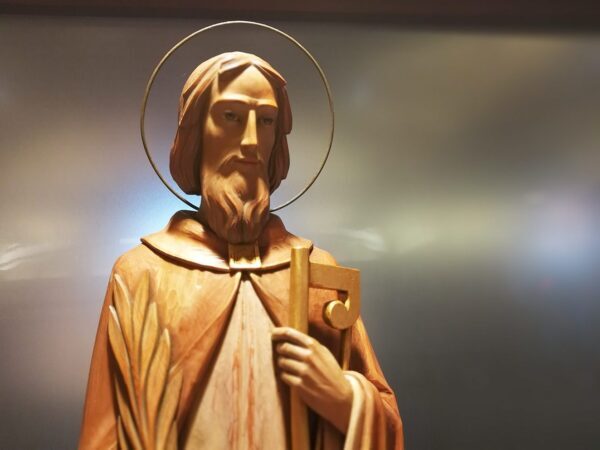
Making a pilgrimage is a journey with prayer. It has some spiritual preparations other than the rest of the journies. Know the patron saint of the Pilgrimage before you go for a pilgrimage. Saint James the Great was one of the Twelve Apostles of Jesus Christ who has the patronage of pilgrims. He is also called James the Elder, he was the first apostle to become a martyr and the only one whose martyrdom was recorded in the New Testament. Son of Zebedee and Salome and brother of John the Apostle, Saint James the Great is the Patron of Pilgrims and Laborers. He is also known as the Patron Saint of Spain.
He was probably born somewhere in Bethsaida or Capernaum, where his father Zebedee lived. His parents appear to have had good social standing. Zebedee was a fisherman at the Sea of Galilee located south of Capernaum and had a few boatmen and hired men as servants. Salome, the wife of Zebedee and mother of James the Great was thought by Zahn to have been the daughter of a priest.
James was one of two sons and was likely to be the elder of the two. With the exception of select passages (Lk 8:51, 9:28; Acts 1:13), Apostle James was always mentioned before John, which suggests that he was the older brother. It is possible that James did not acquire technical training at rabbinical schools like his brother (Acts 4:13). As such, the Jews must have considered them unlearned and having no official standing in their society. Their parents’ social ranking suggests otherwise, and they must have received some education in standard Jewish practices. Despite having unclear education, James had plenty of opportunities to be exposed to Greek life and language, which flourished along the shores of the Sea of Galilee. Saint James, son of Zebedee was called “the Greater” or “the Great” to distinguish him from Saint James “the Lesser” or “the Less,” a son of Alpheus who was believed to have been younger or shorter in stature, as well as James the Just, brother of Jesus.
St James continued to preach for 14 years following the death of Jesus in AD 30. He preached in Samaria and Judea, where he met his death under King Herod Agrippa I. Herod was known for his zeal in Judaism, having shown high regard for the Mosaic Law and Jewish customs. During his reign as king of Judea, the Jews felt threatened by the rapid growth of the Church.
In some traditions, it is believed that Saint James preached Christianity in Spain prior to his death and that James founded an Apostolic see on the peninsula. The origin of these legends can be traced from Compostela and are described briefly in the 12th century Historia Compostelana commissioned by Bishop Diego Gelmirez. Here, it is said that James preached the gospel in Iberia as well as in Israel, and that following his martyrdom, his disciples brought his body across the sea to Iberia before being taken to Santiago de Compostela where it was buried. Saint James, the patron of pilgrims, intimately understands the fears and difficulties of life in pursuit of the way (Jn 14:6). His own pilgrimage began when he stepped out of his father’s boat—representing all that was familiar, safe, and predictable—to follow Christ.