



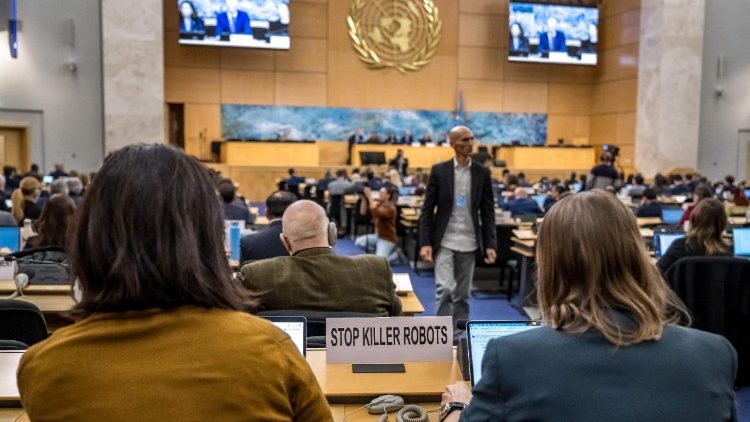
In a position paper submitted to the Seventh Review Conference of the Convention on Certain Conventional Weapons (CCW) in Geneva, held from November 16 to 20, the Holy See called for an immediate moratorium on Lethal Autonomous Weapons Systems (LAWS) and the creation of a legally binding international framework. Echoing Pope Leo XIV’s encyclical Magnifica humanitas, which urges nations to curb the technological arms race and safeguard civilians, the Vatican stated that after more than a decade of international debate and recent consensus from the Group of Governmental Experts, the time has come to turn shared understanding into concrete, operational rules.
At the core of the Holy See’s argument is a fundamental distinction between machine calculation and human moral judgment. While artificial systems can process data, only humans possess conscience and the capacity to recognize others as persons—making it morally unacceptable to delegate irreversible decisions over life and death to algorithms. The paper emphasized that mere technical compliance with international humanitarian law is insufficient, noting that principles like proportionality, unnecessary suffering, and the dictates of public conscience require good faith and prudent human judgment. It also warned that programming errors, biased data, cyberattacks, or unpredictable interactions between rival algorithms could spark rapid, uncontrollable military escalation.
To prevent machines from replacing human agency, the Holy See insisted that human oversight must be effective, self-aware, and genuine rather than merely nominal. Military procedures and interfaces must allow commanders enough time to question system recommendations and withhold lethal force, ensuring that operational speed never overrides moral responsibility. Furthermore, the document stressed that accountability cannot be offloaded onto a machine; those who design, train, authorize, and deploy these technologies must remain fully answerable through clear documentation and operational logs.
Looking ahead, the Vatican reiterated its demand for a strict prohibition on autonomous systems designed to target humans or likely to cause accidental civilian casualties. Clarifying that calling for the “disarming” of technology does not mean rejecting innovation, the paper highlighted how artificial intelligence can instead be harnessed for civilian protection, early warning systems, and verifying arms control treaties. To oversee such peaceful applications, the Holy See also revived its 2021 proposal to establish an International Organization for Artificial Intelligence, modeled on existing global bodies that regulate outer space.