



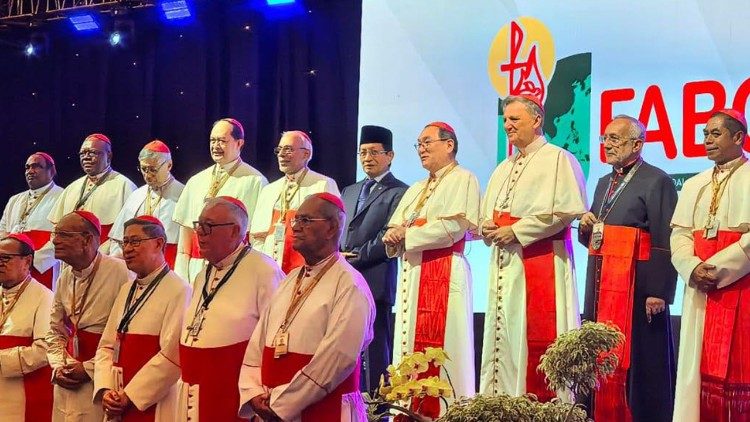
Cardinal Mario Grech, Secretary General of the Synod of Bishops, told participants at the 12th Plenary Assembly of the Federation of Asian Bishops’ Conferences (FABC) that the post-synodal phase must focus on how synodality is lived in the daily life of local Churches.
Speaking in Jakarta, Indonesia on Friday, July 24, during the FABC Assembly that runs until July 26, Cardinal Grech said: “It is not a matter of talking about synodality, but of seeking how to live it in the ordinary life of our Churches.”“The subject of the implementation phase and of the path of the Assemblies is, first of all, the local Church,” he explained. This is not merely an organizational point. A local Church, he said, is “a true manifestation of the Church in a particular place, where the Gospel is proclaimed, the sacraments are celebrated, and the faithful are gathered into communion with Christ.”
Addressing the theme “The Call to Synodal Conversion and the Mission to Be Bridges and Bridge-Builders in Asia,” Cardinal Grech recalled that the universal Church cannot be understood apart from the concrete communities that make it up. “If a local church fails to contribute, it deprives the universal Church of something vital,” he said, because every particular Church brings “unique gifts, experiences, resources, and a distinct witness that God intends to enrich the whole body of Christ.”Reflecting on the synodal journey launched in 2021, the Cardinal said the guiding question was: How can we reach the People of God? From that came a key choice: participation had to be the method, not just the content. “The People of God could not simply be the object; above all, they had to be the subject of the journey.” To listen to the Church, he added, means concretely “to listen to the Churches.”
Cardinal Grech highlighted the importance of reciprocity among Churches sharing their experiences and gifts. The synodal process, he said, is not primarily about producing new texts, but about fostering “a circulation of gifts that strengthens communion and supports the mission.”One innovation from the process was what he called restitutio — continuous feedback. Each stage was returned to local communities to be received and reflected upon again. “The movement was therefore no longer unidirectional, but bidirectional—indeed, circular,” he said. This was necessary, he explained, to keep the process connected to real community life and to ensure that the work of a small number of “experts” did not “steamroll” the ecclesial grassroots.
Speaking specifically to Asia, Cardinal Grech pointed to dialogue with other religions, cultural diversity, the minority status of Christians in many places, and closeness to the poor as areas where the Holy Spirit is at work.“The fundamental question is not primarily what the Churches of Asia will receive from the Synod,” he said, “but rather what gift the Holy Spirit wishes to offer to the whole Church through them.”He called the current “phase of reception” decisive, and “in many respects, the more important one.” The Synod, he stressed, cannot be limited to documents or decisions but must become a lived experience.
On the role of bishops, Cardinal Grech said synodality is also an opportunity to understand the service of authority entrusted to the diocesan bishop. The bishop is called to listen to the People of God and to accompany the Church’s discernment while safeguarding communion.“The implementation of the Synod will bear its fullest fruit when every local Church recognizes itself simultaneously as both the recipient and the bearer of a gift,” he concluded. Through this exchange among Churches, “the Church continues to grow as communion and as mission.”