



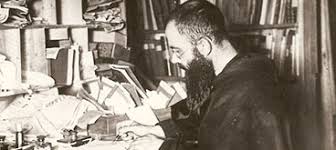
Maximilian Kolbe was a Polish Catholic priest. After the outbreak of World War II, Kolbe was one of the few friars who remained in the monastery. He organized there a temporary hospital. After capturing the town by the Germans, he was arrested on 19 September 1939. Later he was released on 8 December. But again on 28 May 1941, he was arrested and transferred to Auschwitz as prisoner 16670. As a priest, Kolbe was subjected to violent harassment. The guards gave Kolbe a lethal injection of carbolic acid. He died on 14 August 1941 and he was cremated on 15 August on the feast day of Assumption of Mary.
1. Mary Appeared to Him as a Boy
Baptized as Raymund Kolbe, our saint was a normal child and the stories of his childhood don’t have the false patina that Flannery O’Connor said exists in the stories of pious children. Yet there is this one stunning exception. One night in Kolbe’s childhood, Our Lady appeared to him in a dream. She was holding a white crown and a red crown. He later related, “She asked if I was willing to accept either of these crowns. The white one meant that I should persevere in purity and the red that I should become a martyr. I said that I would accept them both.” So, St. Maximillian had a normal childhood, but with one tremendous difference that was to define the course of his life.
2. He always Wished to be a Soldier
As a student, the young Raymond excelled in science, technology, engineering, and mathematics. He also had a passionate interest in all things military. A childhood dream of the priesthood was almost lost for this ardent patriot with a soldier’s heart. He had hoped for a military career defending his beloved Poland. Complications caused him to abandon these plans and he entered the Franciscan novitiate late in 1910 and was ordained in 1918.
He still had a soldier’s heart, but now waged a spiritual war. With several friends a new type of army was founded, the Militia Immaculatae, an army to convert sinners and bring all to love Mary Immaculate.
3. He Founded a Religious Group
By the time he was in his early thirties, Fr. Kolbe founded a religious house near Warsaw, Niepokalanów – the City of the Immaculate, from which to expand his evangelization efforts. Starting with a handful of friars, within a decade it grew to house nearly 1,000! He and a handful of his brothers traveled to Japan, where they opened another house in Nagasaki.
4. He was a Master of the New Media
Fr. Kolbe was a man of his times and thoroughly modern in his evangelization. The friars’ made use of the most modern printing technology and distribution strategies for their materials, their arsenal in the Militia’s spiritual war. They had started a radio station and Fr. Kolbe even had plans for a movie studio.
5. He has a Statue at Westminster Abbey
St. Maximilian Kolbe is among twenty modern martyrs from across the globe who have been honored with a statue on the façade of Westminster Abbey. This priest who had no greater love than to lay down his life can be seen above the west door of the abbey, along with Dietrich Bonhoeffer, Martin Luther King, Jr., and seventeen others.
6. You can Acquire Relics of St. Maximilian
Though St. Maximilian’s body was incinerated at Auschwitz, there are first-class relics available for veneration. Years before the saint’s death, a somewhat prescient barber in his community started saving clippings of Fr. Kolbe’s hair and beard. Parishes may obtain the first-class relic for public veneration through Niepokalanów. The community can also accommodate requests for second-class relics and provide prayer cards with relics.
7. The Prisoner whom St. Maximilian Saved Attended his Canonization
There was one extraordinary man in attendance at St. Maximilian’s canonization: Franciszek Gajowniczek. Though spared the torture of the starvation bunker, Gajowniczek had still suffered greatly. He was in Auschwitz for over five years and his sons did not live to see the day of his release. Those prisoners who had grown so fond of Fr. Kolbe were particularly cruel to Gajowniczek, as they blamed him for the loss of their beloved friend and priest. But he received consolation in 1982, in St. Peter’s Square when the man who offered his life for Franciszek’s was declared a saint.
8. There are St. Maximilian pilgrimage sites, even in America
Niepokalanów is still a thriving community. There is even a museum that pilgrims visit in large numbers. If you live in the United States and your travels will not take you abroad, you can still plan a pilgrimage to the National Shrine of St. Maximilian Kolbe at Marytown in Libertyville, Illinois, about thirty miles north of Chicago.
9. The Pope Declared him the Patron Saint of the Twentieth Century
St. Maximillian is the patron saint of families, prisoners, journalists, political prisoners, drug addicts, and the pro-life movement. St. John Paul II declared him to be “the patron saint of our difficult century.” The evils which made the twentieth century so difficult were not left behind as we moved into the twenty-first century.