



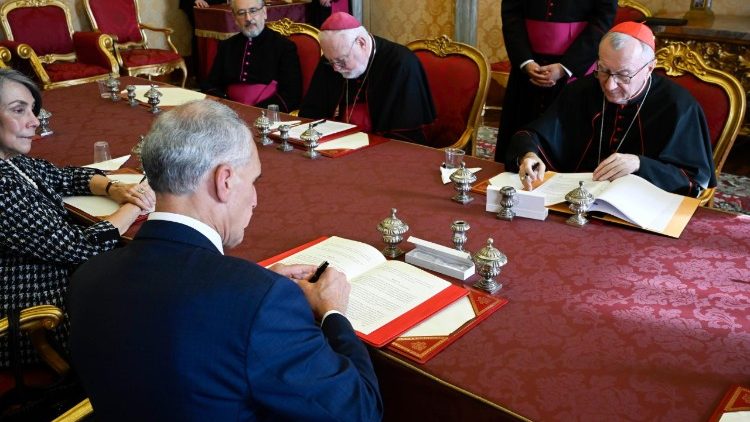
On Thursday, October 22, the Holy See and the Republic of Honduras officially signed a comprehensive bilateral agreement aimed at consolidating their strong diplomatic relations. Held in the Treaty Hall of the Vatican’s Apostolic Palace, the ceremony was led by Cardinal Secretary of State Pietro Parolin and the President of Honduras, Nasry Juan Asfura Zablah.
Comprising 25 articles, the accord safeguards the legal personality of the Catholic Church in Honduras while fostering fruitful cooperation between Church and State to advance the common good, culture, and human values of the Honduran people. Rooted in international human rights standards and the principles of the Second Vatican Council’s Dignitatis Humanae, the agreement reaffirms fundamental rights regarding freedom of thought, conscience, and religion.
Under the terms of the agreement, the Honduran State formally recognizes the Church’s autonomy to govern itself, operate by its own rules, and freely appoint its religious ministers. Key legal protections are also established, including the absolute inviolability of the sacramental seal of confession, the right to conscientious objection, and confidentiality protections for pastoral workers equivalent to the confessional seal.
Furthermore, the accord guarantees the Church’s right to establish and operate educational and charitable institutions across the country. It secures provisions for spiritual assistance and pastoral care in both public and private settings—such as healthcare facilities, social care homes, schools, and penitentiary institutions—while facilitating specialized pastoral care for members of the armed forces and national police.
Following the signing, officials from both delegations met to discuss the Church’s ongoing contributions to Honduran social development, alongside key regional and international matters. Attendees included Vatican Foreign Minister Archbishop Paul Richard Gallagher and Honduran Secretary of State for Foreign Affairs Mireya Agüero de Corrales. The agreement will formally take effect once both parties complete their respective legal ratification procedures and exchange the official instruments of ratification.