



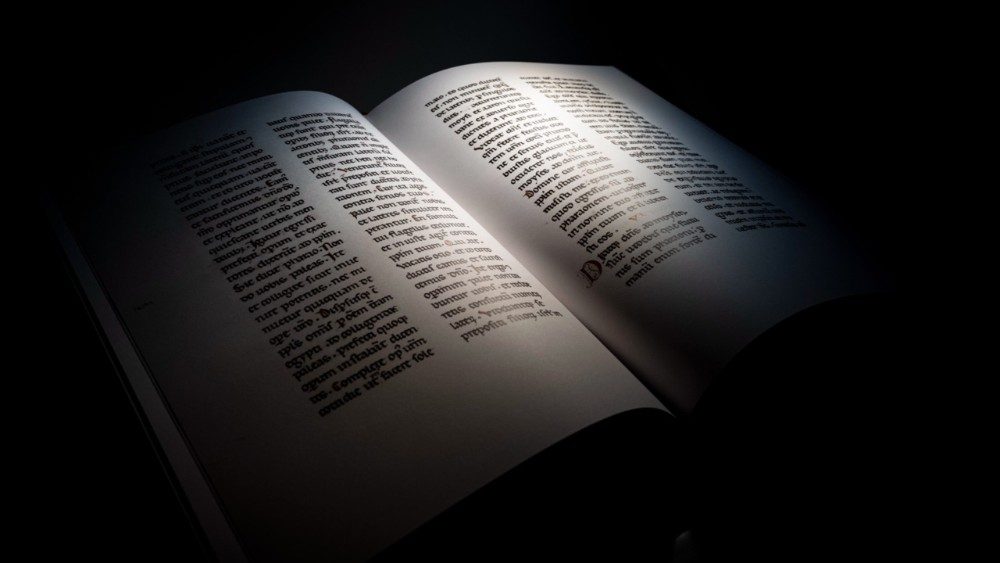
A significant medieval treasure linking faith, history, and craftsmanship is returning to the spotlight through a ambitious new preservation project. The first volume of a faithful facsimile edition of the Bible of Aquileia was formally presented on Sunday to the Pontifical Academy of Sciences and the Pontifical Academy of Social Sciences at the Casina of Pio IV in the Vatican Gardens. Spearheaded by the Scriptorium Foroiuliense Foundation, the ambitious initiative seeks to reproduce all five volumes of the monumental manuscript by 2031.
The original manuscript, preserved in the Treasury of the Cathedral of Gorizia, was written in Gothic book script between the 12th and 13th centuries, with scholarly annotations continuing into the 14th century. Serving as a crucial witness to the literary and spiritual heritage of the Patriarchate of Aquileia, the work reflects a region that was for centuries a dominant ecclesiastical and cultural crossroads in Europe, playing a central role in the development of Western Christian culture.
To bring the historic codex back to life, the project combines cutting-edge digital technology with traditional artisan techniques. High-resolution scanning was first used to map every page and capture the physical characteristics acquired over centuries, creating a permanent digital archive. Craftsmen then used historical formulas to recreate authentic inks, pigments, and materials, hand-assembling the gatherings and binding them in naturally tanned leather with handcrafted metal fittings.
This meticulous reconstruction process has already yielded intriguing codicological discoveries. High-resolution mapping of the manuscript’s physical structure revealed an unusual binding technique that deviates from standard Western bookmaking conventions, prompting renewed debate among scholars regarding where and under what circumstances the text was originally produced.
Designed as a bridge between preservation and global cultural dialogue, the completed five-volume set will be published in a strictly limited run through 2031. Copies have already been designated for international institutions, including Japan’s National Diet Library and the University of Tokyo, demonstrating the project’s capacity to engage diverse cultural traditions through the shared history of writing and bookcraft.