



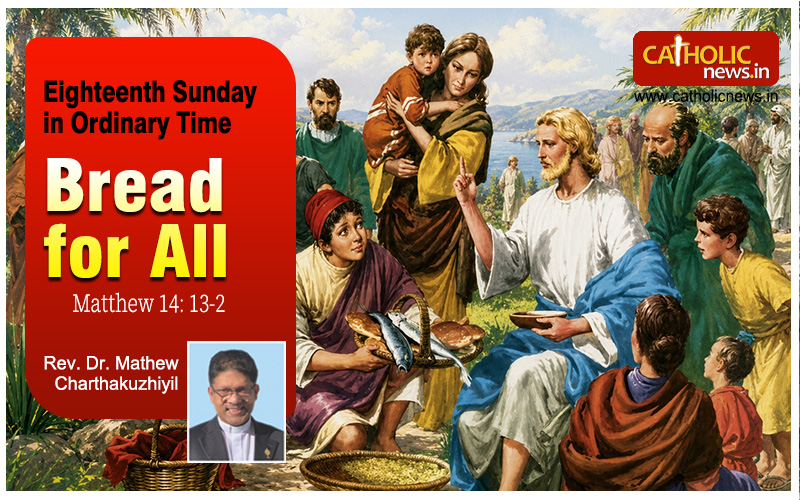
Today’s Gospel begins in sorrow. Jesus has just heard about the death of John the Baptist and withdraws to a deserted place. He desires silence and prayer, but the crowds follow him. When Jesus sees them, he does not become impatient or send them away. The Gospel tells us that he is moved with compassion. He sees their sickness, hunger and confusion. Although his heart is grieving, he makes room for their suffering. This is the first miracle: before the bread is multiplied, compassion grows. Jesus shows us that God never looks upon suffering from a distance. He comes close, heals the sick and feeds the hungry. In him, people encounter someone who cares for the person: body, mind and soul.
As evening approaches, the disciples become anxious. They see the crowd and the emptiness of the place. Their solution is sensible: send the people away to buy food. But Jesus answers: “There is no need for them to go away; give them some food yourselves.” The disciples focus on what they lack: “Five loaves and two fish are all we have here.” They see scarcity; Jesus sees a beginning. He does not ask them to provide what they do not possess. He asks them to place what they have into his hands. This is how God works. We may think time, abilities or resources are too small to make a difference. Jesus says, “Bring them here to me.” What we keep for ourselves remains small; what we entrust to Christ can bless others.
Jesus takes the loaves, looks up to heaven, blesses them, breaks them and gives them to the disciples. These actions point us toward the Eucharist. At every Mass, Christ takes the gifts of bread and wine and gives us something greater: his Body and Blood, his life. Jesus gives the bread to the disciples, and they give it to the people. The disciples do not create the miracle, but they cooperate with it. Their hands become the hands through which Christ feeds the crowd. This is also true. Having received Christ in the Eucharist, we are sent to carry his compassion into the world. The Eucharist is not only food for our consolation. It transforms us into people willing to serve, sacrifice and share ourselves for the good of others.
Everyone eats and is satisfied, and twelve baskets of fragments remain. God’s generosity is abundant and overflowing. Yet this abundance should not make us careless. The disciples gather what remains because every gift of God is precious. The food on our tables, the people who love us, our health, faith, work and time are gifts we take for granted. Saint Augustine observed that the multiplication of the loaves continues in the fields whenever a few grains become a harvest. Because this happens gradually, we call it nature rather than miracle. Faith teaches us to see more deeply. Grace surrounds us in ordinary life. A prayer before meals renews our gratitude to God and reminds us of the hands that planted, harvested, transported and prepared our food.
Dear friends, hunger is not only a lack of bread. People hunger for friendship, forgiveness, encouragement, dignity and the assurance that they are loved. Someone may carry a burden that cannot be seen. We may not solve every problem, but we can refuse to send people away. We can offer a listening ear, a visit, a meal, a word of hope or a little of our time. Jesus still says, “Give them something to eat.” Today, we are those disciples. Let us bring him our five loaves and two fish, whatever gifts we have, and trust him with the result. When our willingness meets his blessing, acts of kindness can become miracles of grace. May Christ, who feeds us at this altar, make us his hands and generous hearts in a hungry world.
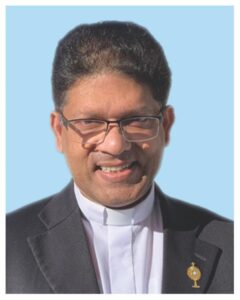
Fr. Mathew Charthakuzhiyil