



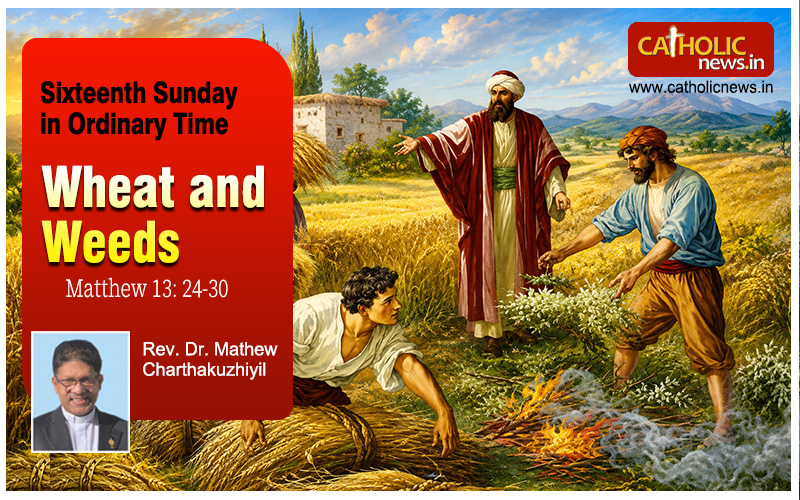
Last week, through the Parable of the Sower, Jesus challenged us to become good soil and to bear abundant fruit. This week, he continues to teach us about the Kingdom of God through another familiar parable. A farmer sows good seed in his field, but during the night an enemy comes and sows weeds among the wheat. When the servants discover what has happened, they ask whether they should pull out the weeds immediately. Surprisingly, the master tells them to wait until the harvest. The wheat and the weeds must grow together for a time. Only at the harvest will the separation take place. This parable reveals an important truth about our world and about our own hearts. God has created everything good, yet evil continues to exist.
The struggle between good and evil is not only something we see in society; it is also something we experience within ourselves. Saint Paul speaks honestly about this inner battle when he writes: “I do not do the good I want, but the evil I do not want is what I do” (Romans 7:19). If a great saint like Paul experienced such a struggle, then we should not be surprised when we face it ourselves. We all know what it means to want to be patient and yet become angry, to desire holiness and yet fall into temptation, to wish to forgive and yet cling to resentment. Paul discovered that victory does not come from human strength alone. When he prayed for help, the Lord answered him: “My grace is sufficient for you, for power is made perfect in weakness” (2 Corinthians 12:9). The Christian life is not about pretending that the struggle does not exist. It is about trusting that God’s grace is stronger than our weakness.
The parable also reminds us that evil is real and active in the world. Jesus says that the enemy came while the people were asleep. The devil constantly seeks to weaken faith, create division, and draw people away from God. The Bible repeatedly teaches us to place our confidence in God rather than in our own strength. The Psalmist proclaims: “Even though I walk through the valley of the shadow of death, I will fear no evil; for you are with me” (Psalm 23:4). The story of Job offers a powerful example of such trust. Although he endured immense suffering and temptation, he remained faithful. Even when others urged him to abandon God, Job declared: “The Lord gave and the Lord has taken away; blessed be the name of the Lord” (Job 1:21).
What, then, can we do about the darkness we see around us? A simple story offers an answer. One evening, as the sun was setting, it asked, “Who will give light to the world after I am gone?” Everything remained silent. Then a small firefly stepped forward and said, “I shall try my best.” The firefly could not illuminate the entire world, but it could bring light to the small place where it was. We often spend much time complaining about the darkness in society, in the Church, or in the world. Jesus asks us instead to become lights. We may not solve every problem, but we can bring kindness where there is hatred, hope where there is despair, and faith where there is doubt.
Dear brothers and sisters, the message of today’s Gospel is both realistic and hopeful. Jesus does not promise that evil will disappear immediately. Wheat and weeds will continue to grow together until the final harvest. Yet he reminds us that God remains in control and that goodness will ultimately triumph. Instead of focusing on the weeds, let us concentrate on becoming good wheat. Every Christian is called to reflect the light of Christ. Today let us answer the Lord with the simple words of the firefly: “I shall try my best.” If each of us makes that commitment, then the Kingdom of God will continue to grow, and the light of Christ will shine more brightly in our world.
Fr. Mathew Charthakuzhiyil