



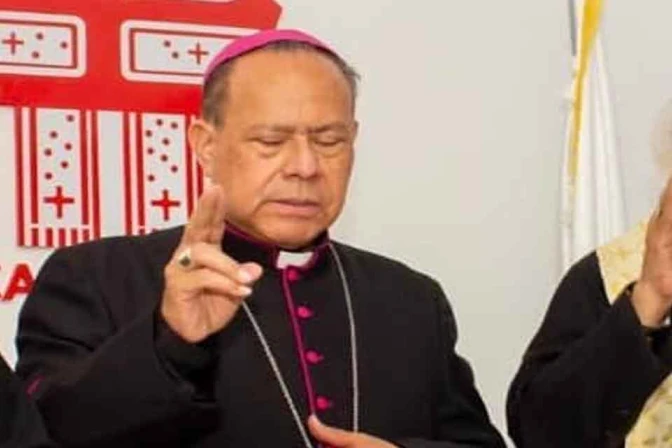
Nicaraguan police rearrested Bishop Emeritus Abelardo Mata on June 30, one day after his initial detention and subsequent release. The 80-year-old prelate is now reportedly under house arrest at his home in Tisma, Masaya, according to the Nicaraguan newspaper La Prensa.Bishop Mata, who served as Bishop of Estelí, was first arrested on Monday, June 29, at a clinic where he had gone for a check-up on his pacemaker. The detention came a day after he presided over a Mass on June 28 in which he prayed for the persecuted Church in Nicaragua, a gesture that reportedly angered the government of Daniel Ortega and Rosario Murillo.Along with the bishop, Father Francisco Morales, parish priest of El Calvario Church in Estelí — where Bishop Mata celebrated the June 28 Mass — and Deacon Wilfred Arauz Rodríguez were also arrested. Both were later released on bail.
Martha Patricia Molina, author of the report Nicaragua: A Persecuted Church, told ACI Prensa on July 2 that Bishop Mata “has no administrative responsibilities with the Diocese of Estelí but continues to collaborate pastorally with that diocese.” She said he attended the Mass at the parish priest’s request, but noted that “the Sandinista dictatorship has prohibited him from appearing in the department of Estelí.”Molina added that the Diocese of Estelí “has always been a focus of repression by the Sandinista dictatorship due to the hatred the dictatorial couple has for Monsignor Rolando José Álvarez, the Apostolic Administrator.” Bishop Álvarez, who has been Apostolic Administrator of Estelí since 2021 when Bishop Mata resigned, currently lives in Rome after being exiled in January 2024 while serving an unjust 26-year prison sentence. He has long been a critic of the Ortega-Murillo government.“The situation in Estelí is worsening because Bishop Emeritus Juan Abelardo Mata has been critical of the abuses committed by the Sandinista dictatorship,” Molina said. She emphasized that only about 10% of attacks against the Catholic Church are reported, because “the rest go unreported due to the fear and caution that priests and laypeople have when reporting them in the media or on social networks.” If Catholics could speak freely, she said, complaints could reach “about 400 per day.”Molina explained that the dictatorship has resumed detaining priests after a pause. “They had stopped kidnapping priests and now they are back to doing the same thing,” she said.
In other cases, priests must report to police stations to testify, and police carry out “continuous checking and harassment” of clergy across the country’s dioceses.The Diocese of Estelí, she said, is now “the most persecuted by the Ortega-Murillo dictatorship after Matagalpa” — Bishop Álvarez’s diocese — and is forced to “function without a head and with only 42% of its clergy.” The shortage complicates pastoral work and increases the workload for active priests, who must also cover for those in exile, deceased, or otherwise unable to minister in Nicaragua. Molina noted that the dictatorship has prohibited diaconal and priestly ordinations in Estelí, as well as in Matagalpa, Jinotega, and Siuna. The bishops of all four dioceses are currently in exile.
Father Edwing Román, vicar of Santa Agatha parish in Miami, Florida, told ACI Prensa that Bishop Mata’s arrest “is yet another example of the persecution of the Catholic Church that the dictatorship wants to silence forever.” He added that “even in exile, that Church continues to console, encourage, and strengthen the people of God in Nicaragua,” pointing to the Sunday homilies of Auxiliary Bishop Silvio Báez of Managua, who has lived in exile since April 2019 and often celebrates Mass at Father Román’s parish.Arturo McFields, former Nicaraguan ambassador to the OAS, expressed concern for Bishop Mata’s health. “We must be vigilant regarding Bishop Mata because his health is delicate and requires professional care. What worries me is that the last people who have been under surveillance by the dictatorship or the police have ended up worse off or even dead,” he told ACI Prensa on July 2.
He cited the case of Brooklyn Rivera, an indigenous leader and political prisoner who died in May at age 73 after more than 970 days in detention. “If the dictatorship is not strongly denounced for what is happening, the regime will not hesitate to orchestrate the death of Bishop Mata, because they harbor a deep resentment towards this man of God for his courage and clarity over many years,” McFields said.A Nicaraguan priest in exile, who asked to remain anonymous to avoid reprisals, told ACI Prensa that the bishop’s arrest “is sad, but it can also be interpreted as showing the fear the dictatorship has of an elderly bishop emeritus, 80 years old (with his illnesses), because his presence as a pastor strengthens the lives of the faithful” and keeps “faith alive.”
He said he hopes the persecution will end and that the Church is preparing “for a future in which we can rebuild not only socially, but also through faith, the Church in Nicaragua, because we also need to do spiritual and pastoral reconstruction work.”Félix Maradiaga, president of the Freedom for Nicaragua Foundation, issued “an urgent appeal to the international community, human rights organizations, the world’s democracies and all people of goodwill to remain vigilant, demand the immediate release of Monsignor Juan Abelardo Mata and all the religious people arbitrarily detained, and firmly condemn this new escalation of repression.” He added: “Nicaragua cannot normalize a dictatorship imprisoning priests, silencing pulpits, and persecuting the faith. The moral voice of the Church has historically accompanied the Nicaraguan people in their most difficult times, and that is precisely why the regime is trying to intimidate it.”