



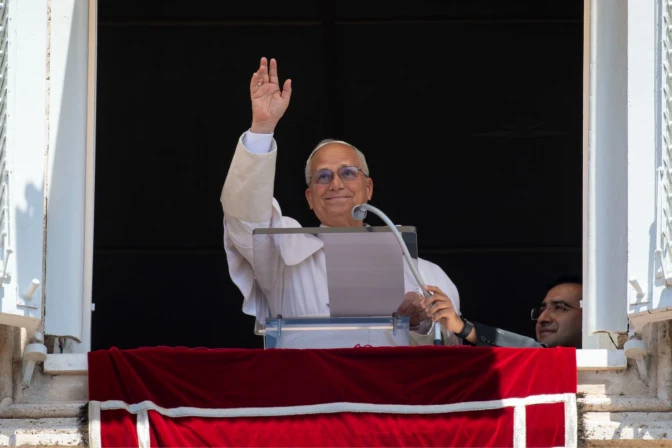
While presiding over the Angelus prayer on Sunday, June 14, before faithful gathered in St. Peter’s Square, Pope Leo XIV affirmed that when the “Gospel is proclaimed and practiced, evil collapses like a disease that ends, like a night that gives way to dawn, like death conquered by the Risen One.” “Today’s Gospel offers us a great gift, because all who hear it are included in Jesus’ gaze,” the Holy Father said, reflecting on the passage from Saint Matthew. “It is a story that reveals the keenness with which he observes, and also tells us what he pays attention to.”
The Pope emphasized that “by becoming our brother, the Son of God looks at people, looks at humanity: he sees the oppression that crushes and the violence that drains strength. He sees the wounds of wars and the emptiness of consumerism.” Jesus, he continued, “sees faces reduced to masks, families broken by evil, and young people deluded by false ideals.”“Jesus sees and loves. He loves and suffers for us, with us: his compassion expresses not only fraternal closeness, but a will to redemption,” he stressed. The Lord, Leo indicated, “knows our heart and cares for it; faced with so many people like ‘sheep without a shepherd’, Christ dedicates himself to all as a good shepherd and, as Lord of the harvest, sends workers into the field of the world.”
The “work that those who follow Jesus must do,” he said, “is to bring God’s comfort to those who suffer: to bring charity where there is misery, hope where there is affliction, faith where there is mistrust.” He recalled that the Gospel mentions the names of the first twelve “workers,” disciples who became apostles and missionaries. The first was “Simon called Peter,” while the last was Judas Iscariot, “to remind us that one can follow Jesus and betray him, but the Gospel continues to be a living and true word for everyone.” “The Good News that transcends the centuries is identical, always young, fresh and liberating: ‘The kingdom of heaven has arrived!’” a message that “is near because in Jesus Christ God becomes neighbor to every man and woman, to every people and nation.”“In this way, Jesus’ gaze transforms reality: full of love, his initiative gives life to a new people, the Church, called to continue the mission of the apostles: ‘Freely you have received, freely give’,” the Pope pointed out.
At the end of his message before the Angelus, the Holy Father reminded all the faithful that “the task of evangelizing is born from the gift of God which in Christ becomes forgiveness for the world, service to the smallest and poorest, commitment to justice.” “Let us ask for the help of the Virgin Mary, full of grace, so that we may respond with joy and courage to the mission to which Jesus calls us,” he concluded.
After the Angelus, the Holy Father thanked God “for the Apostolic Journey that He has allowed me to make in Spain,” and expressed gratitude “to the Spanish people, who have welcomed me with great enthusiasm and devotion; and, in a special way, to His Majesty the King.” “My heartfelt thanks also go to the bishops, to the communities I have visited, and to the entire Church in Spain. May God always bless Spain!” he said. The Pope also remembered newly beatified martyrs: Wenceslas Drbola and John Bula from Moravia, the Polish Salesian priests John Šwierc and eight companions, and Nazareno Lanciotti, a Roman missionary priest beatified June 13 in Mato Grosso, Brazil. “May the example and intercession of these courageous witnesses sustain the mission of the priests and of the entire Church,” he encouraged. He also expressed closeness to the people of the Philippines affected by a 7.8 magnitude earthquake on June 8 that killed at least 62 and injured more than 600. “I pray for the deceased and their families, for the injured, and for all those who are suffering because of this calamity,” Leo said.