



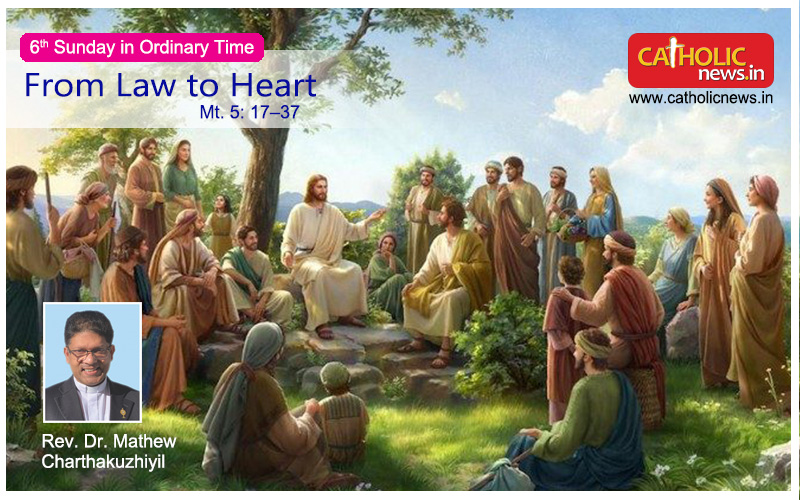
In today’s Gospel, Jesus speaks words that may surprise us and even unsettle us. He says: “Unless your righteousness surpasses that of the scribes and Pharisees, you will not enter the kingdom of heaven.” At first, this sounds demanding, even frightening. The scribes and Pharisees were respected for their strict observance of the law. They knew the commandments well and tried to follow them carefully. Yet Jesus is not criticizing their love for the law. Instead, he is inviting his disciples to go deeper. He is not asking for more rules, more control, or a harsher religion. He is asking for something more personal: a transformed heart. For Jesus, faith is not mainly about appearances or external correctness, but about who we are becoming before God and before one another.
To make this clear, Jesus gives very concrete examples. He speaks about anger, desire, and truthfulness—real experiences from daily life. In each case, he moves from the outward action to the inner attitude. It is not enough, he says, simply not to kill; anger, resentment, and contempt already wound relationships and damage human dignity. It is not enough to avoid adultery; looking at another person with selfish desire turns them into an object instead of respecting them as a person. And it is not enough to avoid false oaths; our simple “yes” and “no” should already be honest and trustworthy. Jesus shows us that sin often begins quietly in the heart, long before it appears in visible actions.
This teaching can feel demanding, and perhaps even uncomfortable. But it is not meant to crush us or fill us with guilt. Jesus is not pointing a finger to condemn; he is opening a path to freedom and healing. Anger, lust, and dishonesty may seem small or private, but they slowly imprison us. Anger hardens the heart and keeps us stuck in bitterness. Uncontrolled desire weakens our ability to love truly. Dishonesty destroys trust and creates fear. Jesus wants to free us from these inner chains. He wants hearts that are whole, truthful, and capable of real love. True righteousness, then, is not about fear of punishment, but about a heart shaped by love.
One of the great Church Fathers, St. Augustine, helps us understand this Gospel well. He famously said: “Love, and do what you will.” Augustine did not mean that everything is allowed. He meant that when love truly guides the heart, our actions will naturally be good. A loving heart does not want to harm, deceive, or use others. Jesus is teaching the same truth in today’s Gospel. He does not abolish the law; he fulfills it by bringing it to its deepest meaning. When the heart is formed by love, anger gives way to patience, desire becomes respect, and words become honest. Love becomes the soul of the law.
For us today, this Gospel is a gentle but serious invitation to look honestly at our own hearts. Where do I hold on to anger instead of seeking reconciliation? Where do my thoughts fail to respect the dignity of others? Are my words simple, truthful, and reliable? Jesus does not expect perfection overnight. He knows our weakness and our struggles. What he asks for is sincerity, humility, and a willingness to grow. With God’s grace, small steps can lead to deep change. As we celebrate the Eucharist, let us ask the Lord for a clean heart, a truthful spirit, and a love that goes beyond the surface. Then our lives will reflect the righteousness Jesus speaks about—a righteousness that does not burden us, but leads us into freedom, peace, and joy.
Fr. Mathew Charthakuzhiyil