



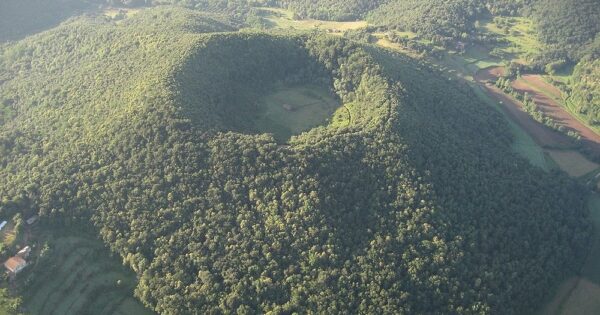
Deep within the La Garrotxa Volcanic Zone Natural Park in Girona, Spain, lies a geological wonder that seamlessly blends the fury of nature with the serenity of faith. The Santa Margarida volcano, a perfectly symmetrical cone-shaped marvel, is home to an ancient hermitage nestled at its very centre. This harmonious union of natural and spiritual beauty is a testament to the region’s rich history and diverse landscape.
The La Garrotxa Volcanic Zone, shaped by eruptions spanning 700,000 years, boasts an impressive collection of volcanic cones, each cloaked in lush vegetation. The Santa Margarida volcano, with its striking symmetry, stands out among its peers. Its history is a tale of geological drama and quiet reverence, with the last major eruption occurring around 11,000 years ago. This powerful phreatomagmatic explosion formed the wide crater that presently cradles the hermitage.
The Garrotxa Volcanic Zone is a region shaped by eruptions that began 700,000 years ago and ceased about 8,000 years ago. It is home to a remarkable collection of volcanic cones, each cloaked in lush vegetation.
Among these, the Santa Margarida volcano is particularly striking – mainly because of its perfectly symmetrical shape.
The Santa Margarida volcano’s history is a tale of intense geological activity and serene tranquillity. A colossal phreatomagmatic eruption around 11,000 years ago shaped the vast crater that dominates the landscape today. Since then, the volcano has been cloaked in a lush forest, with the signs of its fiery past still visible in the remnants of lava flows and pyroclastic deposits that line the Mas el Cros trail, a lesser-known path that reveals the volcano’s hidden secrets.
The hermitage at the centre of the crater is a modest yet significant structure – a classic example of sober Catalan Romanesque style. Originally built in the 12th century, the hermitage has undergone several reconstructions, most notably in 1865, following its destruction in a series of 15th-century earthquakes.
The reason for building it in that place, according to Els Goigs a Llaor de la Santa (traditional Catalan “rhymes (or hymns) in honour of the saint”) was the seemingly miraculous discovery of the image of St. Margaret in the crater itself.
A 14th or 15th century alabaster image of Santa Margarida (Saint Margaret) has survived the test of time, including the devastating earthquakes of the 15th century. Today, a precise replica of the sculpture can be found inside the hermitage, while the original is preserved at the Museo Diocesano de Girona. Visitors can easily access the Santa Margarida volcano, with a nearby parking area offering a short, 30-minute hike to the crater and hermitage. The scenic trail is suitable for all and offers breathtaking views, especially during autumn when the forest transforms into a kaleidoscope of colours.
For those who are seeking a more in-depth experience, the Garrotxa Natural Park offers a 12-kilometer loop that showcases the region’s geological wonders, including the stunning La Fageda d’en Jordà forest and the imposing Croscat volcano, the largest in the Iberian Peninsula. This route highlights the area’s unique blend of natural beauty, medieval charm, and spiritual significance, making it an unforgettable experience.