



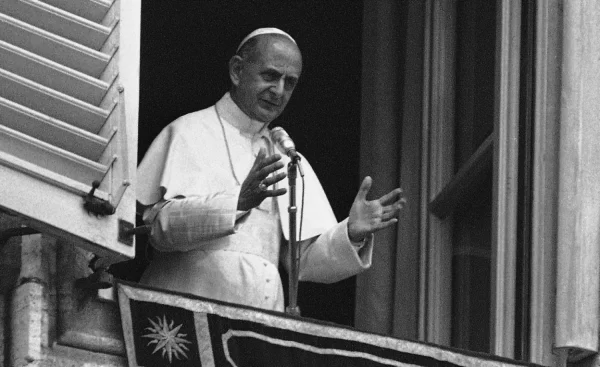
This May 29 we celebrate Pope Saint Paul VI, who published a special Creed that contains several teachings of our Catholic faith, including 3 mysteries of Corpus Christi that can be seen in the Holy Mass and that are important to know.
The Vatican indicates that the Creed of the People of God was pronounced by Paul VI on 30 June 1968 “after the Year of Faith proclaimed on the occasion of the 19th centenary of the martyrdom of the apostles Peter and Paul in Rome.”
Saint Paul VI indicates that this Creed arises amid a world “in which so many truths are either completely denied or put into discussion” and in which some Catholics have fallen seeking to change or innovate.
The saint specifies that the Church should not interrupt the desire to penetrate further into the mysteries of God, but warns that it must be done with great care so that “truths of Christian doctrine are not demolished.”
This profession of faith has 8 great Christian themes such as the Trinity, the Virgin Mary and the Church. When referring to the Eucharist, he professes 3 Eucharistic mysteries that can be seen in the Holy Mass.
“Mysterious presence” of the Lord
The Creed reminds us that the Mass “is the sacrifice of Calvary, which becomes sacramentally present on our altars.”
Likewise, he affirms that at the Last Supper, the bread and wine consecrated by Christ really became his body and blood and that this also happens with the bread and wine consecrated by the priest.
“And we believe that the mysterious presence of the Lord under the appearance of those things (bread and wine), which continue to appear to our senses in the same way as before, is true, real and substantial,” he adds.
The Creed of Paul VI indicates that Christ cannot be present in the Sacrament of the Eucharist except through the conversion of “the whole substance of the bread into his body and the conversion of the whole substance of the wine into his blood.”
This “mysterious conversion is called by the Holy Church conveniently and properly transubstantiation,” he emphasizes.
Then he issues a warning to the theologians and asks that any interpretation of this mystery must maintain that, once the consecration has been carried out, the bread and wine “have ceased to exist” and what remains, under the appearance of the bread and wine, are “the adorable body and blood of Christ”, just as He wanted to remain to unite us.
The Creed also explains that the existence of Christ is unique and indivisible and that he does not multiply, but that “through the sacrament, he is made present in the various places of the earth, where the Eucharistic sacrifice is made.”
He also points out that this same existence is also in the Blessed Sacrament that is in the Tabernacle.
“Therefore we are obliged, by a certainly most gentle obligation, to honour and adore in the Holy Host that our eyes see, the same incarnate Word that they cannot see, and that, however, has been made present before us without having “left the heavens,” states the Creed of Saint Paul VI.